Question: Three charges (–q, +q, and Q) are placed at the vertices of an equilateral triangle. The force on Q due to the charges –q and +q
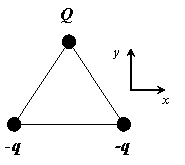
A) points in the positive x direction
B) points in the positive y direction
C) is zero
D) points in the negative x direction
E) points in the negative y direction
Homework Answers

Add Answer to:
Question: Three charges (–q, +q, and Q) are placed at the vertices of an equilateral triangle....
An equilateral triangle has a point charge +q at each othe the three vertices (a,b,c). Another...
 An
equilateral triangle has a point charge +q at each othe the three
vertices (a,b,c). Another point charge Q is placed at D, the
midpoint of the side BC.
Solve for Q if the total electric force on the charge A due to
charges B, C, and D is zero.
The answer is not -1.35q.
PHYSICS Question 11 (of 14) e: 00 points 2 out of 3 attempt Give an exact answer in simplest, reduced form. An equilateral triangle has...
An
equilateral triangle has a point charge +q at each othe the three
vertices (a,b,c). Another point charge Q is placed at D, the
midpoint of the side BC.
Solve for Q if the total electric force on the charge A due to
charges B, C, and D is zero.
The answer is not -1.35q.
PHYSICS Question 11 (of 14) e: 00 points 2 out of 3 attempt Give an exact answer in simplest, reduced form. An equilateral triangle has...
1) The three charges are at the three vertices of an equilateral triangle ?( all angles are 60 degrees) Equilateral side of the triangle 0.5 m a) Draw the forces acting ONLY-on q q 1 and q 2 b) Find...
 1) The three charges are at the three vertices of an equilateral triangle ?( all angles are 60 degrees) Equilateral side of the triangle 0.5 m a) Draw the forces acting ONLY-on q q 1 and q 2 b) Find the components of each force on X and Y axes C) Find the net force on X-axis and the y-axis 43 q2 d) Use Pythagorean Theorem to tind the resultant force e) Use tangent to find the direction (angle) the...
Three identical point charges, Q = +5 C are placed at the vertices of an equilateral...
 Three identical point charges,
Q = +5 C are placed at the vertices of an equilateral triangle as
shown in the figure. The length of each side of the triangle is d =
1.5 cm
I think the answer is 3.46E7 upwards but I'm not sure
SECTION B Do all the Problems) 1) Three identical point charges, Q +5HC are placed at the vertices of an equilateral triangle as shown in the figure. The length of each side of the...
Three identical point charges,
Q = +5 C are placed at the vertices of an equilateral triangle as
shown in the figure. The length of each side of the triangle is d =
1.5 cm
I think the answer is 3.46E7 upwards but I'm not sure
SECTION B Do all the Problems) 1) Three identical point charges, Q +5HC are placed at the vertices of an equilateral triangle as shown in the figure. The length of each side of the...
1) The three charges are at the three vertices of an equilateral triangle ?( all angles...
 1) The three charges are at the three vertices of an equilateral
triangle ?( all angles are 60degrees)
q 1 = + 3.0 µC
q 2 = - 3 .0 µC
q 3 = + 6 .0 µC
1 µC = 10-6
C
Equilateral side of the triangle = 10
cm =0.10 m
Draw the force acting ONLY on q
1by q 2 on the figure .
Label this force F2
b) Find the components of force
F2 ...
1) The three charges are at the three vertices of an equilateral
triangle ?( all angles are 60degrees)
q 1 = + 3.0 µC
q 2 = - 3 .0 µC
q 3 = + 6 .0 µC
1 µC = 10-6
C
Equilateral side of the triangle = 10
cm =0.10 m
Draw the force acting ONLY on q
1by q 2 on the figure .
Label this force F2
b) Find the components of force
F2 ...
5. [5pt] Three identical charges q are placed on the vertices of an equilateral triangle of...
5. [5pt] Three identical charges q are placed on the vertices of an equilateral triangle of side-lengths, a. What charge Q must be placed in the middle of the triangle (equidistant from the three charges q) so that the system is in equilibrium? [ans. Q = -q / sqrt(3)]
Three charges, q1=+q, q2=-q, and q3=+q, are at the vertices of an equilateral triangle, as shown...
 Three charges, q1=+q, q2=-q, and q3=+q, are at the
vertices of an equilateral triangle, as shown in the figure.
***Part A***
Rank the three charges in order of decreasing magnitude of the
electric force they experience. Rank charges from largest to
smallest magnitude of the electric force they experience. To rank
items as equivalent, overlap them.
***Part B***
Give the direction angle, theta, or the net force experienced by
charge 1. Note that theta is measured counterclockwise from the
positive...
Three charges, q1=+q, q2=-q, and q3=+q, are at the
vertices of an equilateral triangle, as shown in the figure.
***Part A***
Rank the three charges in order of decreasing magnitude of the
electric force they experience. Rank charges from largest to
smallest magnitude of the electric force they experience. To rank
items as equivalent, overlap them.
***Part B***
Give the direction angle, theta, or the net force experienced by
charge 1. Note that theta is measured counterclockwise from the
positive...
Problem 2- The three charges are at the three vertices of an equilateral triangle. (All angles...
Problem 2- The three charges are at the three vertices of an equilateral triangle. (All angles are 60degrees), Equilateral side of the triangle = 10 cm =0.10 m q 1 = + 3.0 µC q 2 = +3 .0 µC q 3 = -6.0 µC 1 µC = 10-6 a. Calculate the force acting on on q 2 by q 1 . Name this force F2 . Show formula and calculation here: b) Calculate the force acting on q 2...
Question 3 1 pts The figure shows an equilateral triangle ABC. A positive point charge +q...
 Question 3 1 pts The figure shows an equilateral triangle ABC. A positive point charge +q is located at each of the three vertices A B, and C. Each side of the triangle is of length a. A point charge Q (that may be positive or negative) is placed at the mid-point between B and C a/2 Ref 18-1 Is it possible to choose the value of Q (that is non-zero) such that the force on Q is zero? Explain...
Three identical positive charges q are placed on the corners of an equilateral triangle. What is...
Three identical positive charges q are placed on the corners of an equilateral triangle. What is the magnitude and direction of the force on any one of the charges (assuming they stay in their fixed positions)?
Three identical charges q=1nC are placed in three vertices of an equilateral triangle of side 1m....
Three identical charges q=1nC are placed in three vertices of an equilateral triangle of side 1m. Make a large clear diagram of this situation and find the electric field at the centre of the triangle (where the angle bisectors cross).
 An
equilateral triangle has a point charge +q at each othe the three
vertices (a,b,c). Another point charge Q is placed at D, the
midpoint of the side BC.
Solve for Q if the total electric force on the charge A due to
charges B, C, and D is zero.
The answer is not -1.35q.
PHYSICS Question 11 (of 14) e: 00 points 2 out of 3 attempt Give an exact answer in simplest, reduced form. An equilateral triangle has...
An
equilateral triangle has a point charge +q at each othe the three
vertices (a,b,c). Another point charge Q is placed at D, the
midpoint of the side BC.
Solve for Q if the total electric force on the charge A due to
charges B, C, and D is zero.
The answer is not -1.35q.
PHYSICS Question 11 (of 14) e: 00 points 2 out of 3 attempt Give an exact answer in simplest, reduced form. An equilateral triangle has...
 1) The three charges are at the three vertices of an equilateral triangle ?( all angles are 60 degrees) Equilateral side of the triangle 0.5 m a) Draw the forces acting ONLY-on q q 1 and q 2 b) Find the components of each force on X and Y axes C) Find the net force on X-axis and the y-axis 43 q2 d) Use Pythagorean Theorem to tind the resultant force e) Use tangent to find the direction (angle) the...
 Three identical point charges,
Q = +5 C are placed at the vertices of an equilateral triangle as
shown in the figure. The length of each side of the triangle is d =
1.5 cm
I think the answer is 3.46E7 upwards but I'm not sure
SECTION B Do all the Problems) 1) Three identical point charges, Q +5HC are placed at the vertices of an equilateral triangle as shown in the figure. The length of each side of the...
Three identical point charges,
Q = +5 C are placed at the vertices of an equilateral triangle as
shown in the figure. The length of each side of the triangle is d =
1.5 cm
I think the answer is 3.46E7 upwards but I'm not sure
SECTION B Do all the Problems) 1) Three identical point charges, Q +5HC are placed at the vertices of an equilateral triangle as shown in the figure. The length of each side of the...
 1) The three charges are at the three vertices of an equilateral
triangle ?( all angles are 60degrees)
q 1 = + 3.0 µC
q 2 = - 3 .0 µC
q 3 = + 6 .0 µC
1 µC = 10-6
C
Equilateral side of the triangle = 10
cm =0.10 m
Draw the force acting ONLY on q
1by q 2 on the figure .
Label this force F2
b) Find the components of force
F2 ...
1) The three charges are at the three vertices of an equilateral
triangle ?( all angles are 60degrees)
q 1 = + 3.0 µC
q 2 = - 3 .0 µC
q 3 = + 6 .0 µC
1 µC = 10-6
C
Equilateral side of the triangle = 10
cm =0.10 m
Draw the force acting ONLY on q
1by q 2 on the figure .
Label this force F2
b) Find the components of force
F2 ...
 Three charges, q1=+q, q2=-q, and q3=+q, are at the
vertices of an equilateral triangle, as shown in the figure.
***Part A***
Rank the three charges in order of decreasing magnitude of the
electric force they experience. Rank charges from largest to
smallest magnitude of the electric force they experience. To rank
items as equivalent, overlap them.
***Part B***
Give the direction angle, theta, or the net force experienced by
charge 1. Note that theta is measured counterclockwise from the
positive...
Three charges, q1=+q, q2=-q, and q3=+q, are at the
vertices of an equilateral triangle, as shown in the figure.
***Part A***
Rank the three charges in order of decreasing magnitude of the
electric force they experience. Rank charges from largest to
smallest magnitude of the electric force they experience. To rank
items as equivalent, overlap them.
***Part B***
Give the direction angle, theta, or the net force experienced by
charge 1. Note that theta is measured counterclockwise from the
positive...
 Question 3 1 pts The figure shows an equilateral triangle ABC. A positive point charge +q is located at each of the three vertices A B, and C. Each side of the triangle is of length a. A point charge Q (that may be positive or negative) is placed at the mid-point between B and C a/2 Ref 18-1 Is it possible to choose the value of Q (that is non-zero) such that the force on Q is zero? Explain...
Most questions answered within 3 hours.
-
Where is the error in this code sequence?
String s1 = "Hello";
String s2 = "ello";...
asked 10 months ago -
Financial data for Joel de Paris, Inc., for last year
follow:
Joel de Paris, Inc.
Balance...
asked 10 months ago -
Consider this reaction:
Al2(SO4)3 (aq)+ BaCl3
(aq) Al2Cl6 (aq)- +
3BaSO4(s) . What is the...
asked 10 months ago -
Suppose that Savneet is considering increasing her
recent random sample from 20 car rentals to 40...
asked 10 months ago -
Trucks arrive at an unloading terminal at an average rate of 120
per hour.
Trucks arrive...
asked 10 months ago -
Why are methanol and ethanol completely soluble in water while
octanol is not very little soluble....
asked 10 months ago -
A facilities manager at a university reads in a research report
that the mean amount of...
asked 10 months ago -
When the CuSO4 is rehydrated by adding water to the anhydrous
compound, is this an endothermic...
asked 10 months ago -
A ray of sunlight is passing from diamond into crown glass; the
angle of incidence is...
asked 10 months ago -
A block of mass 0.249 kg is placed on top of a light, vertical
spring of...
asked 10 months ago -
how do the kidneys compensate in the presences of acidosis
a) trigger hyperventilate
b) reserve acid...
asked 10 months ago -
Question 501 pts
The rental rate of capital to the firm increases. Which of the
following...
asked 10 months ago