Gas turbine engines like those of jet aircraft operate on a thermodynamic cycle known as t...
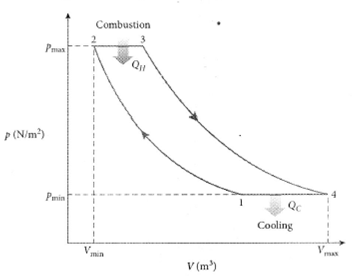
Gas turbine engines like those of jet aircraft operate on a thermodynamic cycle known as the Brayton cycle. The basic Brayton cycle, as shown in the figure, consists of two adiabatic processes—the compression and the expansion of gas through the turbine—and two isobaric processes. Heat is transferred to the gas during combustion in a constant- pressure process (path from point 2 to point 3) and removed from the gas in a heat exchanger during a constant-pressure process (path from point 4 to point 1). The key parameter for this cycle is the pressure ratio, defined as  and this is the only parameter needed to calculate the efficiency of a Brayton engine.
a) Determine an expression for the efficiency.
b) Calculate the efficiency of a Brayton engine thai uses a diatomic gas and has a pressure ratio of 10.0.
Step-by-Step Solution
THINK:
The efficiency can be expressed in terms of heat transfers . Using ideal gas law, we calculate the efficiency of the engine.
RESEARCH:
Efficiency of heat engine is 
For isobaric process, 
For adiabatic process, 
From ideal gas law, 
CALCULATE:
(a) For adiabatic process, the compression and expansion of the gas through the
turbine is given by



Expression for the efficiency of a Brayton engine:


(b) For a diatomic gas, pressure ratio, 
Efficiency of the Brayton engine:

ROUND:
(b) Efficiency of the Brayton engine, 
Most questions answered within 3 hours.
-
Calculating the space time for parallel reactions. m-Xylene is reacted over a ZSM-5 zeolit...
-
Determine Vo and ID for the networks of Fig. 2.160.FIG. 2.160
-
The truck travels along a circular road that has a radius of 50 m at a speed of 4 m/s. F...
-
A state legislature enacted a statute that required any motorcycle operator or passenger...
-
A 1024 × 1024 8-bit image with 5.3 bits/pixel entropy [computed from its histogram using E...
-
In Problem 3.3, we estimated the equationwhere we now report standard errors along with th...
-
In each of the following cases, deduce the nature of the light that is consistent with the...
-
Solve Example 20.5 such that the x, y, z axes move with curvilinear translation, Ω = 0 in...
-
In Fig. 6.43, if i = cos 4t and v = sin 4t, the element is:(a)a resistor(b) a capacitor(c)...
-
Sketch vo for each network of Fig. 2.181 for the input shown.FIG. 2.181
-
(Supplement B) Computing and Reporting Cash Flow Effectsof Sale of Plant and EquipmentDuri...
-
A 350-mL spherical flask contains 0.075 mol of an ideal gas at a temperature of 293 K. Wha...