Two cylinders, A and B, have equal inside diameters and pistons of negligible mass connect...
Two cylinders, A and B, have equal inside diameters and pistons of negligible mass connected by a rigid rod. The pistons can move freely, The rod is a short tube with a valve. The valve is initially closed (see the figure).
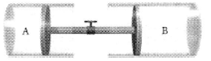
Cylinder A and its piston are thermally insulated, and cylinder B is in thermal contact with a thermostat, which has temperature θ = 27.0 °C. Initially, the piston of cylinder A is fixed, and inside the cylinder is a mass, m = 0.320 kg, of argon at a pressure higher than atmospheric pressure. Inside cylinder B, there is a mass of oxygen at normal atmospheric pressure. When the piston of cylinder A is freed, it moves very slowly, and at equilibrium, the volume of the argon in cylinder A is eight times higher, and the density of the oxygen has increased by a factor of 2. The thermostat receives heat Q' = 7.479 ∙104 J.
a) Based on the kinetic theory of an ideal gas, show that the thermodynamic process taking place in the cylinder A satisfies TV2/3 = constant.
b) Calculate p, V, and T for the argon in the initial and final states.
c) Calculate the final pressure of the mixture of the gases if the valve in the rod is opened.
The molar mass of argon is µ = 39.95 g/mol.
Step-by-Step Solution
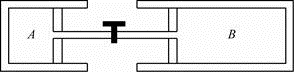
THINK: Cylinder A is at a higher pressure than cylinder B. When the piston is released the argon will expand and move the piston. This will in turn compress the oxygen in cylinder B since the pistons are connected by a rigid rod. Cylinder A is insulated and so processes occurring are adiabatic. Cylinder B is in contact with a thermostat that maintains the cylinder at a constant temperature and so the oxygen in this cylinder therefore expands or contracts isothermally. (Assuming the cylinders are thermally isolated initially.) The cylinders have the same internal diameters and their pistons are connected by a rigid rod so, when free to move, the pistons will move until the pressures are equal in each cylinder. Also, since the pistons are connected by a rigid rod, the total volume in the two cylinders must remain constant. In the final part of the question, if the valve is opened, the gases will mix and heat will flow from the hotter cylinder to the cooler one (2nd Law Thermodynamics) until the equilibrium temperature is reached. The piston will move to maintain equal pressure in each cylinder. When the valve is opened to connect the two cylinders, the equilibrium temperature will be 300. K since the thermostat will maintain the now connected cylinders at this temperature.
SKETCH:
RESEARCH:
(a) For cylinder A changes are adiabatic \((\mathrm{Q}=0)\) and so (by the First Law Thermodynamics) \(\Delta E_{=i}=-W\). For adiabatic process:
\(p V_{Y}=\) constant
or equivalently
\(T V-1=\) constant \(\quad(2)\)
Work, \(W\), done by the argon is at the expense of its internal energy. Work done during an adiabatic expansion as temperature changes from TAi to TAf is:
\(W=n_{A} R\left(T_{A f}-T_{A i}\right) /(1-g)\)
Argon is a monotonic gas. According to kinetic theory of gases considering the elastic collisions of molecules with the walls of the container (see Chapter 19 for details) it can be shown that for a monotonic gas: \(\mathrm{Y}=5 / 3\).
(b) For cylinder B changes occur isothermally so (by the First Law Thermodynamics) \(\Delta E_{z=1}=0\) and \(Q=W\). For a gas undergoing compression isothermally:
\(p V=\) constant.
Work done on the gas during an isothermal compression as volume changes from VBi to VBf is:
\(W=n_{\mathrm{s}} R T \ln \left(V_{\mathrm{J} /} / V_{\mathrm{J}}\right)\),
(5)
and this is expelled as heat to the thermostat to maintain the temperature.
(c) After the piston is released, the connected pistons move so that the argon expands, while the oxygen contracts until the pressures are equal in each cylinder:
\(p \mathrm{Af}=p \mathrm{Bf}\)
\(p_{\lambda f}=p_{A} V_{A}{ }^{3} / V_{M^{\prime}}{ }^{3}\)
For cylinder B using equation (4): \(p_{\bar{\Sigma}} V_{\mathrm{si}}=p_{\mathrm{si}} V_{\mathrm{JI}} \mathrm{so}\) that
SIMPLIFY:
(a)For cylinder A using equation (2): \(T V_{Y}-1=\) constant and \(y=5 / 3\) for argon. Therefore \(y-1=\) \(2 / 3\), and \(T V^{\gamma-1}=T V^{23}\), as required. For cylinder \(\mathrm{A}\) it is given that when the piston is released the
equivalently (since \(82 / 3=4)\) that
TAf \(=1 / 4\) TAi.
(b) For cylinder B it is given that the density, \(\rho B f\), of the oxygen after the compression is twice the original density, \(\rho\) Bi. Density is \(\rho=m / V\) and this means that the volume of oxygen in cylinder B after the compression is \(V_{\mathrm{sE}}=m / \gamma_{\mathrm{s} E}=m / 2 r_{\mathrm{s}} .\) That is,
\(V_{\mathrm{JE}}=1 / 2 V_{\overline{\mathbf{x}}}\)
CALCULATE:
(a) For cylinder A: Mass of Argon \(=0.320 \mathrm{~kg}=320 . \mathrm{g} .\) Number of moles of Argon \(\mathrm{nA}=\) mass in grams/molar mass \(=320 . / 39.95=8.0100\)
(b) Using equations (6), (7) and (8):
Now using result (10) and the given fact that for cylinder A the volume increases from VAi to VAf \(=8\) VAi implies that in equation \((11): \mathrm{pAf}=\mathrm{pAi}(1 / 8) 5 / 3=\mathrm{pBf}=2 \mathrm{pBi}=2 \mathrm{~atm}=202.65 \mathrm{kPa}\), since
it is given that the original pressure in cylinder \(\mathrm{B}\) is normal atmospheric pressure \((101.325 \mathrm{kPa})\). Therefore the original pressure of the argon in cylinder \(\mathrm{A}\) is \(\mathrm{p}_{k}=\mathrm{s}^{5 \mathrm{~s}} \cdot(2 \mathrm{~atm})=64 \mathrm{~atm}=6484.8 \mathrm{kPa}\). The final pressure after expansion is \(\mathrm{pAf}=2 \mathrm{~atm}=202.65 \mathrm{kPa}\).
(c) Work done during the adiabatic expansion using equations (3) and (9) is:
\(W=n A R(T A f-T A i) /(1-\gamma)=(8.0100\) mol \()(8.31 \mathrm{~J} \mathrm{~mol}-1 \mathrm{~K}-1)(1 / 4 \mathrm{TA}-\mathrm{TAi}) /(1-5 / 3)=74.79 \mathrm{TAi}\)
JK-1
This can be equated to the heat received by the thermostat \(7.479 \cdot 10^{4} \mathrm{~J}\). This means that for the argon: \(\quad \mathrm{TAi}=1000 . \mathrm{K} .\) Using equation \((9): \mathrm{TAf}=1 / 4 \mathrm{TAi}=250 . \mathrm{K}\).
(d) For an ideal gas \(\mathrm{pV}=\mathrm{nRT}\) and so for the argon, using the above results for TAi, TAf, pAi, pAf
\(V_{x}=n_{A} R T_{x} / p_{x}=(8.00 \mathrm{~mol})\left(8.31 \mathrm{~mol}^{-1} \mathrm{JK}^{-1}\right)(1000 . \mathrm{K}) /\left(64 \cdot 101.325 \cdot 10^{3} \mathrm{~Pa}\right)=0.01025 \mathrm{~m}^{3}\)
\(V_{A t}=n_{\mathrm{A}} R T_{A t} / p_{A f}=(8.00 \mathrm{~mol})\left(8.31 \mathrm{~mol}^{-1} \mathrm{JK}^{-1}\right)(250 . \mathrm{K}) /\left(2 \cdot 101.325 \cdot 10^{3} \mathrm{~Pa}\right)=0.08201 \mathrm{~m}^{3}\) (check:
\(\left.V_{A f}=0.08201 \mathrm{~m}^{3}=8 V_{x}=8 \cdot 0.01025 \mathrm{~m}^{3}\right)\)
(e) Since the total volumes of cylinders \(A\) and \(B\) must remain constant it follows that:
So the total volume at any time is:
\(0.01025+0.1435=0.1537 \mathrm{~m} 3\)
\((\) check: \(V A f+V B f=0.08201 m 3+0.1435 / 2 m 3=0.1537 \mathrm{~m} 3)\)
(f) For cylinder \(\mathrm{B}\) : It is in contact with a thermostat that maintains the cylinder at a constant temperature of \(270 \mathrm{C}=273+27=300 . \mathrm{K}\). Work done during an isothermal compression using equation (5) is:
\(W=n_{\mathrm{s}} R T \ln \left(V_{\mathrm{I}:} / V_{\mathrm{J}}\right)=n\left(8.31 \mathrm{~mol}^{-1} \mathrm{JK}^{-1}\right)(300 \cdot \mathrm{K}) \ln \left(1 / 2 V_{\mathrm{si}} / V_{\mathrm{s}}\right)=-n_{\overline{\mathrm{s}}}\left(1728 \mathrm{~J} \mathrm{~mol}^{-1}\right)\)
where \(n B\) is the number of moles of oxygen in cylinder \(B\).
(g) The oxygen, maintained at 300. \(\mathrm{K}\) by the thermostat, is warmer than the argon \((250 . \mathrm{K})\) after the pressures equal in the cylinders. When the valve is opened to connect the two cylinders, the equilibrium temperature will be \(300 . \mathrm{K}\) since the thermostat will maintain the now connected cylinders at this temperature. The final pressure in the connected cylinders can be found using \(p V=n R T\) with \(T=300 . \mathrm{K}\) and the known \(\mathrm{n}\), the total number of moles of oxygen and argon. Additionally, equation (13) can be used to find the number of moles of oxygen:
\(1728 n_{\mathrm{s}}=7.479 \cdot 10^{4} \mathrm{nB}=43.28\). The total number of moles of gas is: \(8+43.28=51.28\), so that the pressure in the connectedcylinders is:
\(p=n R T / V=(51.28 \mathrm{~mol})\left(8.31 \mathrm{~mol}^{-1} \mathrm{~J} \mathrm{~K}^{-1}\right)(300 . \mathrm{K}) /\left(0.15375 \mathrm{~m}^{3}\right)\)
\(=831.486 \mathrm{kPa}=8.206 \mathrm{~atm}\)
ROUND: Quote all values to three significant figures:
\(\mathrm{pAi}=64.0 \mathrm{~atm}=6.48 \mathrm{MPa}\)
\(\mathrm{pAf}=2.00 \mathrm{~atm}=0.0203 \mathrm{MPa}\)
\(\mathrm{TAi}=1.00 \cdot 10^{3} \mathrm{~K}\)
\(\mathrm{TAf}=250 . \mathrm{K}\)
\(\mathrm{VAi}=0.0103 \mathrm{~m} 3\)
\(V A f=0.0820 \mathrm{~m} 3\)
Final pressure when connected is: \(p=0.831 \mathrm{MPa}=8.21\) atm.
DOUBLE CHECK:The final pressure when pistons were connected, after the valve was opened is more than it was when they were not connected. This is as expected since heat flows into the cylinders to heat the argon to 300 K. The final pressure is less than it initially was when the piston was fixed, again this seems reasonable as at that time the argon was much hotter.
Most questions answered within 3 hours.
-
Calculating the space time for parallel reactions. m-Xylene is reacted over a ZSM-5 zeolit...
-
Determine Vo and ID for the networks of Fig. 2.160.FIG. 2.160
-
The truck travels along a circular road that has a radius of 50 m at a speed of 4 m/s. F...
-
A state legislature enacted a statute that required any motorcycle operator or passenger...
-
A 1024 × 1024 8-bit image with 5.3 bits/pixel entropy [computed from its histogram using E...
-
In Problem 3.3, we estimated the equationwhere we now report standard errors along with th...
-
In each of the following cases, deduce the nature of the light that is consistent with the...
-
Solve Example 20.5 such that the x, y, z axes move with curvilinear translation, Ω = 0 in...
-
In Fig. 6.43, if i = cos 4t and v = sin 4t, the element is:(a)a resistor(b) a capacitor(c)...
-
Sketch vo for each network of Fig. 2.181 for the input shown.FIG. 2.181
-
(Supplement B) Computing and Reporting Cash Flow Effectsof Sale of Plant and EquipmentDuri...
-
A 350-mL spherical flask contains 0.075 mol of an ideal gas at a temperature of 293 K. Wha...