
Homework Answers
Answer:
According to data-
- Crispr-Cas9 (Clustered Regularly Interspaced Short Palindromic Repeats) system is a recent technique of genetic engineering utilising the bacterial endonuclease Cas9 (Crispr associated endonuclease).
- In this technique, a guideRNA is used to find out the target DNA sequence which needs to be modified (knock-out/ repression/ activation). Guide RNA contains 2 moieties, the first one is the anchor which contains the target sequence and the second one is the scaffold which binds Cas9 protein.
- Cas9 binds to the guide RNA scaffold by surface expressed positively charged groups forming a riboprotein complex. The target sequence is approximately 10-20 base pairs in length, should be unique and must contain a PAM sequence just downstream where Cas9 endonuclease can act upon.
- PAM sequence or protospacer adjacent motif is the region which is recognized by Cas9 (for example Cas9 endonuclease from Streptococcus pyogenes recognizes the sequence 5’-NGG-3’).
- Cas9 can bind to any PAM sequence available but its endonuclease activity will depend upon the binding intensity with which the guide RNA binds the target sequence.
Answer 1:
 Answer 2:
5’-...CTCGAGCCACGCGAAGCTTCAGG...-3’
Target PAM
Answer 3:
Cas9 cleaves 3 nucleotides upstream of the PAM sequence.
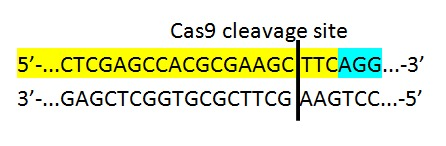
Answer 4:
Guide RNA sequence that is complementary to the target sequence
3’-GAGCUCGGTGCGCUUCGAAG-5’
-------------------------------------------------------###########################------------------------------------------------------ please give me positive vote
Add Answer to:
PART 3: Designing a Guide RNA You will now design your own guide RNA to inactivate...
3. The partial gene (DNA) sequence below contains multiple PAM sequences. Highlight six PAM sequences in...
 3. The partial gene (DNA) sequence below contains multiple PAM sequences. Highlight six PAM sequences in the top (5' to 3) strand. 5'-GCACGGCGGAGCGGTTCTTGGCAGCGGCCGCACGATCTCGTTGCCGCCGG- 3' 3-CGTGCCGCCTCGCCAAGAACCGTCGCCGGCGTGCTAGAGCAACGGCGGCC- 5' Once Cas9 binds to a PAM sequence, it unwinds the DNA. If the guide RNA matches the DNA sequence next to the PAM, the guide RNA will bind to the complementary DNA strand. If not, the DNA will zip back together and Cas9 will keep binding to other PAM sequences until it finds the...
Please have a different answer than the other post, and use layman's terms as well hhmi...
 Please have a different answer than the other post, and use
layman's terms as well
hhmi Biolnteractive Using CRISPR to identify the Functions of Butterfly Genes Activity Student Handout This document is made available by the Howard Hughes Medical Institute. Using this document, you agree to use this document in accordance with the Terms of Use. INTRODUCTION Scientists have determined the complete DNA sequences of the genomes for many organisms, including humans. By analyzing patterns in those sequences, they can...
Please have a different answer than the other post, and use
layman's terms as well
hhmi Biolnteractive Using CRISPR to identify the Functions of Butterfly Genes Activity Student Handout This document is made available by the Howard Hughes Medical Institute. Using this document, you agree to use this document in accordance with the Terms of Use. INTRODUCTION Scientists have determined the complete DNA sequences of the genomes for many organisms, including humans. By analyzing patterns in those sequences, they can...
1) You have two human liver cells (A and B) and you hypothesize that the insulin...
1) You have two human liver cells (A and B) and you hypothesize that the insulin receptor gene in Cell A has a mutation in exon 1 and Cell B contains the wild type sequence. You extract genomic DNA from each of the cells. Of the following, what would be the most efficient (quick, precise and relatively cheap) way to test your hypothesis. a. Isolate protein from both cells, purify the insulin receptor, and determine the amino acid content. b. Sequence the...
Below is a portion of DNA sequence, introns are shown in bold. Determine which strand contains...
Below is a portion of DNA sequence, introns are shown in bold. Determine which strand contains a start codon and could serve as the template for synthesis of an mRNA molecule. 5’ ATCGCGCTCAGCTAGTACCGATCAGCAGTCAGCAGTCAGCATCGGT 3’ (top) 3’ TAGCGCGAGTCGATCATGGCTAGTCGTCAGTCGTCAGTCGTAGCCA 5’ (bottom) a. Which strand will serve as the template strand for transcription? b. Based on the template strand you have chosen, write the mature mRNA sequence on your answer sheet in the 5’ to 3’ direction. Be sure to label 5’ and...
where does transcription begin 3. List the major types of RNA and include what they code...
 where does transcription begin
3. List the major types of RNA and include what they code for, their function in the cell and which type is translated. 4. If a bacterial protein has 2,500 amino acids long, how many nucleotide pairs long is the ger sequence that codes for it? 5. Where does transcription begin? 6. What is the template and nontemplate strands of DNA? 7. Why is only one strand transcribed, and is the same strand of DNA always...
where does transcription begin
3. List the major types of RNA and include what they code for, their function in the cell and which type is translated. 4. If a bacterial protein has 2,500 amino acids long, how many nucleotide pairs long is the ger sequence that codes for it? 5. Where does transcription begin? 6. What is the template and nontemplate strands of DNA? 7. Why is only one strand transcribed, and is the same strand of DNA always...
6a) You want to use homologous recombination to generate a mouse that does not express a functional XPC gene (‘Knock-out...
6a) You want to use homologous recombination to generate a mouse that does not express a functional XPC gene (‘Knock-out’ or KO). To do this, you want to delete exon 10 and replace it with a gene that confers resistance to the drug Neomycin (NEO. The usual second selection with tk we discussed in class is not shown here). Using the diagram as a guide: illustrate on the diagram where you expect crossing over to occur and (below the diagram)...
Can someone please help with these two questions? Thank you. 4. Here is an RNA transcript...
 Can someone please help with these two questions? Thank you.
4. Here is an RNA transcript freshly transcribed from a gene. It is immature, meaning that it has not been processed yet into a mature mRNA. a) If you could zoom in on this molecule, what two things would you observe at the molecular level that would indicate to you that it is RNA and not DNA? b) Which end of the molecule was the last bit to be transcribed,...
Can someone please help with these two questions? Thank you.
4. Here is an RNA transcript freshly transcribed from a gene. It is immature, meaning that it has not been processed yet into a mature mRNA. a) If you could zoom in on this molecule, what two things would you observe at the molecular level that would indicate to you that it is RNA and not DNA? b) Which end of the molecule was the last bit to be transcribed,...
please help answer these questions 3. What are the similarities, differences, advantages, and disadvantages of CRISPR-based...
 please help answer these questions
3. What are the similarities, differences, advantages, and disadvantages of CRISPR-based gene editing versus Zinc-finger nucleases and TALENS? 4. What is crRNA and what does it do? 5. What is tracrRNA and what does it do? 6. What is the PAM sequence and what is its significance? 7. What can nuclease-deficient Cas9 (acas) proteins be used for? 8. You want to insert DNA encoding an epitope tag to the end of a specific gene you...
please help answer these questions
3. What are the similarities, differences, advantages, and disadvantages of CRISPR-based gene editing versus Zinc-finger nucleases and TALENS? 4. What is crRNA and what does it do? 5. What is tracrRNA and what does it do? 6. What is the PAM sequence and what is its significance? 7. What can nuclease-deficient Cas9 (acas) proteins be used for? 8. You want to insert DNA encoding an epitope tag to the end of a specific gene you...
2) On your first day working in my lab, you obtain the following DNA sequence: 3'...
 2) On your first day working in my lab, you obtain the following DNA sequence: 3' AATTATACACGATGAAGCTTGTGACAGGTTTCCAATCATTAA 5 5' TTAATATGTGCTACTTCGAACACTGTECCAAAGGTTAGTAATT 3' a) What are the two possible RNA molecules that could be transcribed from this DNA? Indicate the 5' and 3' ends of the RNA. b) Only one of these two RNA molecules can actually be translated. Explain why. c) It turns out that the RNA molecule that can be translated is the mRNA for p53. What is the amino...
Questions 11-15: Gene structure/Splicing problem. "Protein X" consists of a total of 431 amino acids. Your...
 Questions 11-15: Gene structure/Splicing problem. "Protein X" consists of a total of 431 amino acids. Your colleague, techniques) the a biochemist, has purified the protein and determined (via complicated and messy chemical sequence of the first 37 amino acids in the protein, which she has reported to you as follows: HN- MSNITVDDELNLSREQQGFAEDDFIVIKEERETSLSP . nwhile, you have isolated a genomic clone of the gene that codes for protein X, and determined the DNA equence of the first 227 bases from the...
 3. The partial gene (DNA) sequence below contains multiple PAM sequences. Highlight six PAM sequences in the top (5' to 3) strand. 5'-GCACGGCGGAGCGGTTCTTGGCAGCGGCCGCACGATCTCGTTGCCGCCGG- 3' 3-CGTGCCGCCTCGCCAAGAACCGTCGCCGGCGTGCTAGAGCAACGGCGGCC- 5' Once Cas9 binds to a PAM sequence, it unwinds the DNA. If the guide RNA matches the DNA sequence next to the PAM, the guide RNA will bind to the complementary DNA strand. If not, the DNA will zip back together and Cas9 will keep binding to other PAM sequences until it finds the...
 Please have a different answer than the other post, and use
layman's terms as well
hhmi Biolnteractive Using CRISPR to identify the Functions of Butterfly Genes Activity Student Handout This document is made available by the Howard Hughes Medical Institute. Using this document, you agree to use this document in accordance with the Terms of Use. INTRODUCTION Scientists have determined the complete DNA sequences of the genomes for many organisms, including humans. By analyzing patterns in those sequences, they can...
Please have a different answer than the other post, and use
layman's terms as well
hhmi Biolnteractive Using CRISPR to identify the Functions of Butterfly Genes Activity Student Handout This document is made available by the Howard Hughes Medical Institute. Using this document, you agree to use this document in accordance with the Terms of Use. INTRODUCTION Scientists have determined the complete DNA sequences of the genomes for many organisms, including humans. By analyzing patterns in those sequences, they can...
 where does transcription begin
3. List the major types of RNA and include what they code for, their function in the cell and which type is translated. 4. If a bacterial protein has 2,500 amino acids long, how many nucleotide pairs long is the ger sequence that codes for it? 5. Where does transcription begin? 6. What is the template and nontemplate strands of DNA? 7. Why is only one strand transcribed, and is the same strand of DNA always...
where does transcription begin
3. List the major types of RNA and include what they code for, their function in the cell and which type is translated. 4. If a bacterial protein has 2,500 amino acids long, how many nucleotide pairs long is the ger sequence that codes for it? 5. Where does transcription begin? 6. What is the template and nontemplate strands of DNA? 7. Why is only one strand transcribed, and is the same strand of DNA always...
 Can someone please help with these two questions? Thank you.
4. Here is an RNA transcript freshly transcribed from a gene. It is immature, meaning that it has not been processed yet into a mature mRNA. a) If you could zoom in on this molecule, what two things would you observe at the molecular level that would indicate to you that it is RNA and not DNA? b) Which end of the molecule was the last bit to be transcribed,...
Can someone please help with these two questions? Thank you.
4. Here is an RNA transcript freshly transcribed from a gene. It is immature, meaning that it has not been processed yet into a mature mRNA. a) If you could zoom in on this molecule, what two things would you observe at the molecular level that would indicate to you that it is RNA and not DNA? b) Which end of the molecule was the last bit to be transcribed,...
 please help answer these questions
3. What are the similarities, differences, advantages, and disadvantages of CRISPR-based gene editing versus Zinc-finger nucleases and TALENS? 4. What is crRNA and what does it do? 5. What is tracrRNA and what does it do? 6. What is the PAM sequence and what is its significance? 7. What can nuclease-deficient Cas9 (acas) proteins be used for? 8. You want to insert DNA encoding an epitope tag to the end of a specific gene you...
please help answer these questions
3. What are the similarities, differences, advantages, and disadvantages of CRISPR-based gene editing versus Zinc-finger nucleases and TALENS? 4. What is crRNA and what does it do? 5. What is tracrRNA and what does it do? 6. What is the PAM sequence and what is its significance? 7. What can nuclease-deficient Cas9 (acas) proteins be used for? 8. You want to insert DNA encoding an epitope tag to the end of a specific gene you...
 2) On your first day working in my lab, you obtain the following DNA sequence: 3' AATTATACACGATGAAGCTTGTGACAGGTTTCCAATCATTAA 5 5' TTAATATGTGCTACTTCGAACACTGTECCAAAGGTTAGTAATT 3' a) What are the two possible RNA molecules that could be transcribed from this DNA? Indicate the 5' and 3' ends of the RNA. b) Only one of these two RNA molecules can actually be translated. Explain why. c) It turns out that the RNA molecule that can be translated is the mRNA for p53. What is the amino...
 Questions 11-15: Gene structure/Splicing problem. "Protein X" consists of a total of 431 amino acids. Your colleague, techniques) the a biochemist, has purified the protein and determined (via complicated and messy chemical sequence of the first 37 amino acids in the protein, which she has reported to you as follows: HN- MSNITVDDELNLSREQQGFAEDDFIVIKEERETSLSP . nwhile, you have isolated a genomic clone of the gene that codes for protein X, and determined the DNA equence of the first 227 bases from the...
Most questions answered within 3 hours.
-
Where is the error in this code sequence?
String s1 = "Hello";
String s2 = "ello";...
asked 10 months ago -
Financial data for Joel de Paris, Inc., for last year
follow:
Joel de Paris, Inc.
Balance...
asked 10 months ago -
Consider this reaction:
Al2(SO4)3 (aq)+ BaCl3
(aq) Al2Cl6 (aq)- +
3BaSO4(s) . What is the...
asked 10 months ago -
Suppose that Savneet is considering increasing her
recent random sample from 20 car rentals to 40...
asked 10 months ago -
Trucks arrive at an unloading terminal at an average rate of 120
per hour.
Trucks arrive...
asked 10 months ago -
Why are methanol and ethanol completely soluble in water while
octanol is not very little soluble....
asked 10 months ago -
A facilities manager at a university reads in a research report
that the mean amount of...
asked 10 months ago -
When the CuSO4 is rehydrated by adding water to the anhydrous
compound, is this an endothermic...
asked 10 months ago -
A ray of sunlight is passing from diamond into crown glass; the
angle of incidence is...
asked 10 months ago -
A block of mass 0.249 kg is placed on top of a light, vertical
spring of...
asked 10 months ago -
how do the kidneys compensate in the presences of acidosis
a) trigger hyperventilate
b) reserve acid...
asked 10 months ago -
Question 501 pts
The rental rate of capital to the firm increases. Which of the
following...
asked 10 months ago