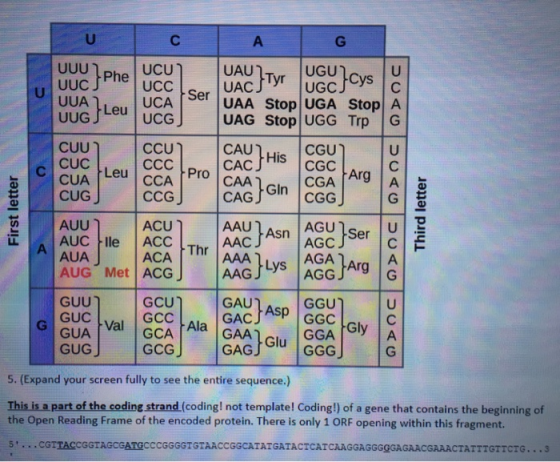
5.1 the underlined bold TAC is an ATG on the other strand. Is this a start codon? why?
5.2. does the underlined bold ATG open an ORF? why?
5.3 which ATG seems to be a valid start codon? Copy the sequence into the answer box and make the start codon bold and underlined. Split the ORF portion into codons fone blank between codons, like this ATG CCC GGG.... Keep the font Courier to keep all symbols equal width. If the copying process drops the font, change the font of this and next few lines to Courier 12 or 14pts. Make sure to keep formatting of characters (e.g. "bold underlined G - you will need it. Expand the window to the right if needed.)
5.4. Write in (above, under the corresponding codons) the mRNA sequence read from this DNA
5.5. In the next line type in (in 3-letter code) the sequence of the polypeptide chain encoded. (continue as long as you can).
Homework Answers


Add Answer to:
5.1 the underlined bold TAC is an ATG on the other strand. Is this a start codon? why?
Below is a portion of DNA sequence, introns are shown in bold. Determine which strand contains...
Below is a portion of DNA sequence, introns are shown in bold. Determine which strand contains a start codon and could serve as the template for synthesis of an mRNA molecule. 5’ ATCGCGCTCAGCTAGTACCGATCAGCAGTCAGCAGTCAGCATCGGT 3’ (top) 3’ TAGCGCGAGTCGATCATGGCTAGTCGTCAGTCGTCAGTCGTAGCCA 5’ (bottom) a. Which strand will serve as the template strand for transcription? b. Based on the template strand you have chosen, write the mature mRNA sequence on your answer sheet in the 5’ to 3’ direction. Be sure to label 5’ and...
4. In the following sequence, we see a stop codon (in bold) followed by a start...
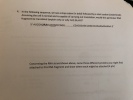 4. In the following sequence, we see a stop codon (in bold) followed by a start codon (Underlined) Assuming the cell is normal and is capable of carrying out translation, would this particular RNA fragment be translated (explain why or why not) (6 pts)? 5'-AUCGAUAACUAUGCCCG..G ACGGAGCUAGCCCAAAAAAAAAAA-3 Concerning the RNA strand shown above, name three different proteins you might find attached to this RNA fragment and show where each might be attached (4 pts)
why the answer is B d start codon in groups of three bases Answer 3. The...
 why the answer is B
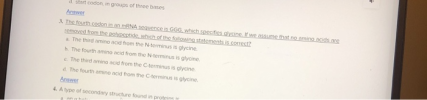
d start codon in groups of three bases Answer 3. The fourth codon in an mRNA sequence is GGG which specifies glycine. If we assume that no omino Acids are removed from the polypeptide, which of the following statements is correct? a. The third amino acid from the N-terminus is glycine. h. The fourth amino acid from the N-terminus is glycine. The third amino acid from the C-terminus is glycine, d. The fourth amino acid...
why the answer is B
d start codon in groups of three bases Answer 3. The fourth codon in an mRNA sequence is GGG which specifies glycine. If we assume that no omino Acids are removed from the polypeptide, which of the following statements is correct? a. The third amino acid from the N-terminus is glycine. h. The fourth amino acid from the N-terminus is glycine. The third amino acid from the C-terminus is glycine, d. The fourth amino acid...
50 LAB 2 Genetics EXERCISE 10 PROTEIN SYNTHESIS Work with a partner to complete this exercise...
 50 LAB 2 Genetics EXERCISE 10 PROTEIN SYNTHESIS Work with a partner to complete this exercise and answer the questions that follow. You will use the DNA strand from Exercise to make the protein for which it codes STEP 1 Review the imaginary strand of DNA below. Note the complementary base pairs. AGCAATCCGTCTTGG TCGTTAGG CAGAACC STEP 2 Draw the DNA strand separating down the middle las in the beginning of DNA replication STEP 3 Draw the free-floating RNA bases linking...
Overview The purpose of this activity is to help the students to understand how replication, tran...
 TranslationOverview:The purpose of this activity is to help the students to understand how replication, transcription, and translation are connected. Students will use a sequence from a bacterial gene that confers resistance to antibiotics (carbapenems). They will be asked to apply the knowledge obtained in the class lecture to (1) find the promoter in the sequence, (2) determine the amino acid sequence of a fragment of the polypeptide, (3) "reverse translate" a fragment of the polypeptide, and (4) identify mutations in...
 4. In the following sequence, we see a stop codon (in bold) followed by a start codon (Underlined) Assuming the cell is normal and is capable of carrying out translation, would this particular RNA fragment be translated (explain why or why not) (6 pts)? 5'-AUCGAUAACUAUGCCCG..G ACGGAGCUAGCCCAAAAAAAAAAA-3 Concerning the RNA strand shown above, name three different proteins you might find attached to this RNA fragment and show where each might be attached (4 pts)
 why the answer is B
d start codon in groups of three bases Answer 3. The fourth codon in an mRNA sequence is GGG which specifies glycine. If we assume that no omino Acids are removed from the polypeptide, which of the following statements is correct? a. The third amino acid from the N-terminus is glycine. h. The fourth amino acid from the N-terminus is glycine. The third amino acid from the C-terminus is glycine, d. The fourth amino acid...
why the answer is B
d start codon in groups of three bases Answer 3. The fourth codon in an mRNA sequence is GGG which specifies glycine. If we assume that no omino Acids are removed from the polypeptide, which of the following statements is correct? a. The third amino acid from the N-terminus is glycine. h. The fourth amino acid from the N-terminus is glycine. The third amino acid from the C-terminus is glycine, d. The fourth amino acid...
 50 LAB 2 Genetics EXERCISE 10 PROTEIN SYNTHESIS Work with a partner to complete this exercise and answer the questions that follow. You will use the DNA strand from Exercise to make the protein for which it codes STEP 1 Review the imaginary strand of DNA below. Note the complementary base pairs. AGCAATCCGTCTTGG TCGTTAGG CAGAACC STEP 2 Draw the DNA strand separating down the middle las in the beginning of DNA replication STEP 3 Draw the free-floating RNA bases linking...
 TranslationOverview:The purpose of this activity is to help the students to understand how replication, transcription, and translation are connected. Students will use a sequence from a bacterial gene that confers resistance to antibiotics (carbapenems). They will be asked to apply the knowledge obtained in the class lecture to (1) find the promoter in the sequence, (2) determine the amino acid sequence of a fragment of the polypeptide, (3) "reverse translate" a fragment of the polypeptide, and (4) identify mutations in...
Most questions answered within 3 hours.
-
Where is the error in this code sequence?
String s1 = "Hello";
String s2 = "ello";...
asked 11 months ago -
Financial data for Joel de Paris, Inc., for last year
follow:
Joel de Paris, Inc.
Balance...
asked 11 months ago -
Consider this reaction:
Al2(SO4)3 (aq)+ BaCl3
(aq) Al2Cl6 (aq)- +
3BaSO4(s) . What is the...
asked 11 months ago -
Suppose that Savneet is considering increasing her
recent random sample from 20 car rentals to 40...
asked 11 months ago -
Trucks arrive at an unloading terminal at an average rate of 120
per hour.
Trucks arrive...
asked 11 months ago -
Why are methanol and ethanol completely soluble in water while
octanol is not very little soluble....
asked 11 months ago -
A facilities manager at a university reads in a research report
that the mean amount of...
asked 11 months ago -
When the CuSO4 is rehydrated by adding water to the anhydrous
compound, is this an endothermic...
asked 11 months ago -
A ray of sunlight is passing from diamond into crown glass; the
angle of incidence is...
asked 11 months ago -
A block of mass 0.249 kg is placed on top of a light, vertical
spring of...
asked 11 months ago -
how do the kidneys compensate in the presences of acidosis
a) trigger hyperventilate
b) reserve acid...
asked 11 months ago -
Question 501 pts
The rental rate of capital to the firm increases. Which of the
following...
asked 11 months ago