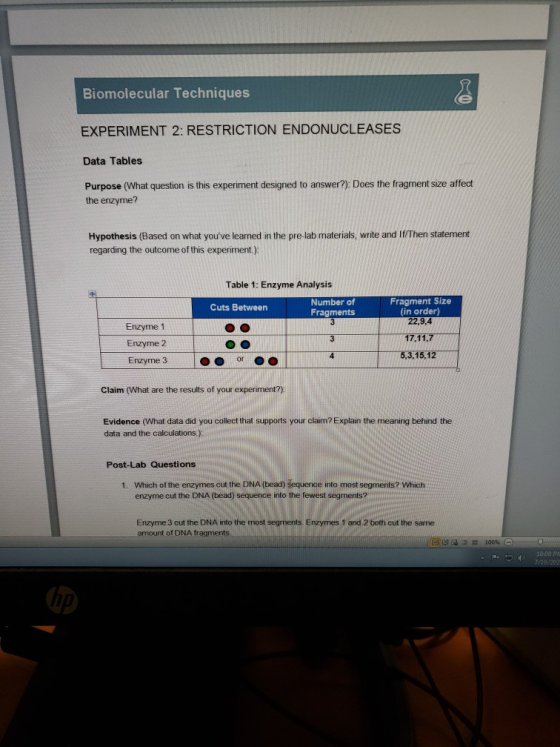
what is the purpose, claim,hypothesis and evidence for restriction endonucleases lab
Homework Answers
Restriction endonucleases are enzymes that cleave nucleic acids at or in the vicinity of a given specific (recognition) site on the nucleic acids. As a result of the cleavage, multiple bands are formed from 1 intact nucleic acid molecule. The number of fragments formed depend on the number of recognition sites present on that particular nucleic acid molecule.
Purpose of the experiment: To determine whether the enzymes under study are endonucleases and are able to cleave the given nucleic acid template molecule.
Hypothesis: The enzymes are endonucleases and cleave the given nucleic acid molecule.
If this hypothesis holds true, then find the number of recognition sites present in the given nucleic acid molecule.
Claim: The 2 enzymes under study are endonucleases wither enzyme 1 having 2 recognition sites, enzyme 2 having 2 recognition sites and enzyme 3 having 3 recognition sites. ( Here, we are assuming that the template nucleic acid is a linear molecule).
Evidence: The number of fragments tells us about the number the
recognition sites. Assuming that it's a linear nucleic acid
molecule, cleaving at 1 site would result in 2 fragments, hence the
number of sites will be 1 less that the number of fragments
formed.
The size of the fragments tell us about the location of the
recognition and/or cleavage sites.
Add Answer to:
what is the purpose, claim,hypothesis and evidence for
restriction endonucleases lab
Biomolecular Techniques EXPERIMENT 2: RESTRICTION...
RESTRICTION DIGEST ANALYSIS QUESTIONS(true or yes = A: false or no = b) 1. Larger DNA...
 RESTRICTION DIGEST ANALYSIS QUESTIONS(true or yes = A: false or no = b) 1. Larger DNA fragments appear near the bottom of the gel. 2. Larger DNA fragments move more rapidly through the gel. D ONA that has many restriction sites for a certain endonuclease will be cut into more fragmets than DNA with fewer restriction sites. 4. Cutting DNA with many different endonucleases will result in more DNA fragments. 5. Restriction enzymes all recognize the same base sequence when...
please help me with these questions Lab 8 Extension Activity: Plasmid Mapping and Restriction Enzymes Mapping...
 please help me with these questions
Lab 8 Extension Activity: Plasmid Mapping and Restriction Enzymes Mapping the Plasmid The first step in mapping a plasmid is to determine how many times a restriction site is found on that plasmid. Examine the results for plasmid 55 as an example. The data given in the following table are for the double digest using EcoRI and Pstl. Also, giving are the data for single digests by the individual enzymes. The numbers in the...
please help me with these questions
Lab 8 Extension Activity: Plasmid Mapping and Restriction Enzymes Mapping the Plasmid The first step in mapping a plasmid is to determine how many times a restriction site is found on that plasmid. Examine the results for plasmid 55 as an example. The data given in the following table are for the double digest using EcoRI and Pstl. Also, giving are the data for single digests by the individual enzymes. The numbers in the...
A. Your lab To see if you understand what you did in our lab, answer the...
 A. Your lab To see if you understand what you did in our lab, answer the following based in the procedures for the restriction digest and the gel electrophoresis. 1. Using the PGLO map on p7 of the gel electrophoresis procedure, predict the size of the fragments generated by each enzyme EcoRI Hindill, and Pst! (the sizes you would expect to see on the gel.) (6 pts) Hindill -8 fragments were produced by the restriction enzyme. 2. Answer the calculation...
Experiment 1: Virtual Microscope Purpose (What question is this experiment designed to answer?): Hypothesis (Based on...
Experiment 1: Virtual Microscope Purpose (What question is this experiment designed to answer?): Hypothesis (Based on what you’ve learned in the pre-lab materials, write and If/Then statement regarding the outcome of this experiment.): Claim (What are the results of your experiment?): Evidence (What data did you collect that supports your claim? Explain the meaning behind the data and the calculations.):
please answer question numbe 2. Restriction endonucleases are bacterial enzymes that recognize, bind, and cut DNA...
 please answer question numbe 2.
Restriction endonucleases are bacterial enzymes that recognize, bind, and cut DNA strands at specific recognition sequences. They evolved to protect bacteria from bacterial viruses and are very useful for a wide variety of molecular biology applications. Some of the more common ones include EcoRI which recognizes the 6 bp sequence 5 'GAATTC 3' and cleaves the phosphodiester backbone after the G. Hind III_(AAGCTT), BamHI (G|GATCC), Pstl (CTGCAG), Not! (GC|GGCCGC), Ndel (CATATG) Kpnl (GGTAC^C), Bgl II...
please answer question numbe 2.
Restriction endonucleases are bacterial enzymes that recognize, bind, and cut DNA strands at specific recognition sequences. They evolved to protect bacteria from bacterial viruses and are very useful for a wide variety of molecular biology applications. Some of the more common ones include EcoRI which recognizes the 6 bp sequence 5 'GAATTC 3' and cleaves the phosphodiester backbone after the G. Hind III_(AAGCTT), BamHI (G|GATCC), Pstl (CTGCAG), Not! (GC|GGCCGC), Ndel (CATATG) Kpnl (GGTAC^C), Bgl II...
command 145 Genetics Assignment Genomic Analysis 1. Some bacteria normally produce endonucleases for what purpose? a)...
 command 145 Genetics Assignment Genomic Analysis 1. Some bacteria normally produce endonucleases for what purpose? a) necessary digestion of their own genome b) defense against viral infection c) bacteria never make endonucleases naturally 2. A blunt cutter produces DNA fragments with complementary overhanging regions. a) True b) False 3. Which of the following DNA sequences (when double-stranded) most likely represents a restriction endonuclease site for a 6-mer cutter? a) AGTAAGCTTC c) AGAGAGCCAA b) GGTAGATTCC d) None of the above 4....
Please help me answer these, thank you! What is an auxotrophic bacteria? A bacteria that cannot...
 Please help me answer these, thank you!
What is an auxotrophic bacteria? A bacteria that cannot complete a metabolic pathway after a pair-wise feeding experiment O A bacteria that cannot complete a metabolic pathway due to a defective enzyme. A bacteria that can use its metabolic pathways to photosynthesize. A bacteria that can use its metabolic pathways to produce prodigiosin. What is agarose gel electrophoresis? Using electricity to run macromolecules through a gel-like medium to separate by size Using electricity...
Please help me answer these, thank you!
What is an auxotrophic bacteria? A bacteria that cannot complete a metabolic pathway after a pair-wise feeding experiment O A bacteria that cannot complete a metabolic pathway due to a defective enzyme. A bacteria that can use its metabolic pathways to photosynthesize. A bacteria that can use its metabolic pathways to produce prodigiosin. What is agarose gel electrophoresis? Using electricity to run macromolecules through a gel-like medium to separate by size Using electricity...
Chromosomal and plasmid DNA can be cut into manageable pieces by restriction enzymes. Using agarose gel...
 Chromosomal and plasmid DNA can be cut into manageable pieces by
restriction enzymes. Using agarose gel electrophoresis, the DNA
fragments can be separated on a gel, based on their lengths. In
order to see the fragments, a stain is typically added to the gel.
The size of each fragment can be determined by comparing each one
to a DNA molecular weight marker of known size.
Below is a map of pBR22 plasmid. The position and base pair
number of the...
Chromosomal and plasmid DNA can be cut into manageable pieces by
restriction enzymes. Using agarose gel electrophoresis, the DNA
fragments can be separated on a gel, based on their lengths. In
order to see the fragments, a stain is typically added to the gel.
The size of each fragment can be determined by comparing each one
to a DNA molecular weight marker of known size.
Below is a map of pBR22 plasmid. The position and base pair
number of the...
on the me but not with the larger fragments on o t and more and record...
 on the me but not with the larger fragments on o t and more and record med in the h 3. Determine the distracted for each bund data bere 4. Determine the distance traveled for each and generated in the double digest and record data bere tion Endonuclease Digestion and Gel Electrophoresis of DNA 185 VI. RESTRICTION MAPPING The different DNA fragments generated by different map DNA. For example, specific DNA on 2000 nucleotides in las Rl or Hind and...
28) le M ore Ullowing experiments transformation C) UV light mutation experiment B) Yeast Complementation experiment...
 28) le M ore Ullowing experiments transformation C) UV light mutation experiment B) Yeast Complementation experiment D) Transduction experiment 26) It red-colored flowers (Rare dominant over white colored flowers and wrinkled seeds (Ware dominant over smooth seeds, then the genotype RRww would appear as A) red, smooth ) white, smooth mooth red, wrinkled red, wrinkled D) white,wrinkled 29) Which of the following techniques is commonly used by Csi agents to solve crime, paternity cases, and identify victims, by matching human...
 RESTRICTION DIGEST ANALYSIS QUESTIONS(true or yes = A: false or no = b) 1. Larger DNA fragments appear near the bottom of the gel. 2. Larger DNA fragments move more rapidly through the gel. D ONA that has many restriction sites for a certain endonuclease will be cut into more fragmets than DNA with fewer restriction sites. 4. Cutting DNA with many different endonucleases will result in more DNA fragments. 5. Restriction enzymes all recognize the same base sequence when...
 please help me with these questions
Lab 8 Extension Activity: Plasmid Mapping and Restriction Enzymes Mapping the Plasmid The first step in mapping a plasmid is to determine how many times a restriction site is found on that plasmid. Examine the results for plasmid 55 as an example. The data given in the following table are for the double digest using EcoRI and Pstl. Also, giving are the data for single digests by the individual enzymes. The numbers in the...
please help me with these questions
Lab 8 Extension Activity: Plasmid Mapping and Restriction Enzymes Mapping the Plasmid The first step in mapping a plasmid is to determine how many times a restriction site is found on that plasmid. Examine the results for plasmid 55 as an example. The data given in the following table are for the double digest using EcoRI and Pstl. Also, giving are the data for single digests by the individual enzymes. The numbers in the...
 A. Your lab To see if you understand what you did in our lab, answer the following based in the procedures for the restriction digest and the gel electrophoresis. 1. Using the PGLO map on p7 of the gel electrophoresis procedure, predict the size of the fragments generated by each enzyme EcoRI Hindill, and Pst! (the sizes you would expect to see on the gel.) (6 pts) Hindill -8 fragments were produced by the restriction enzyme. 2. Answer the calculation...
 please answer question numbe 2.
Restriction endonucleases are bacterial enzymes that recognize, bind, and cut DNA strands at specific recognition sequences. They evolved to protect bacteria from bacterial viruses and are very useful for a wide variety of molecular biology applications. Some of the more common ones include EcoRI which recognizes the 6 bp sequence 5 'GAATTC 3' and cleaves the phosphodiester backbone after the G. Hind III_(AAGCTT), BamHI (G|GATCC), Pstl (CTGCAG), Not! (GC|GGCCGC), Ndel (CATATG) Kpnl (GGTAC^C), Bgl II...
please answer question numbe 2.
Restriction endonucleases are bacterial enzymes that recognize, bind, and cut DNA strands at specific recognition sequences. They evolved to protect bacteria from bacterial viruses and are very useful for a wide variety of molecular biology applications. Some of the more common ones include EcoRI which recognizes the 6 bp sequence 5 'GAATTC 3' and cleaves the phosphodiester backbone after the G. Hind III_(AAGCTT), BamHI (G|GATCC), Pstl (CTGCAG), Not! (GC|GGCCGC), Ndel (CATATG) Kpnl (GGTAC^C), Bgl II...
 command 145 Genetics Assignment Genomic Analysis 1. Some bacteria normally produce endonucleases for what purpose? a) necessary digestion of their own genome b) defense against viral infection c) bacteria never make endonucleases naturally 2. A blunt cutter produces DNA fragments with complementary overhanging regions. a) True b) False 3. Which of the following DNA sequences (when double-stranded) most likely represents a restriction endonuclease site for a 6-mer cutter? a) AGTAAGCTTC c) AGAGAGCCAA b) GGTAGATTCC d) None of the above 4....
 Please help me answer these, thank you!
What is an auxotrophic bacteria? A bacteria that cannot complete a metabolic pathway after a pair-wise feeding experiment O A bacteria that cannot complete a metabolic pathway due to a defective enzyme. A bacteria that can use its metabolic pathways to photosynthesize. A bacteria that can use its metabolic pathways to produce prodigiosin. What is agarose gel electrophoresis? Using electricity to run macromolecules through a gel-like medium to separate by size Using electricity...
Please help me answer these, thank you!
What is an auxotrophic bacteria? A bacteria that cannot complete a metabolic pathway after a pair-wise feeding experiment O A bacteria that cannot complete a metabolic pathway due to a defective enzyme. A bacteria that can use its metabolic pathways to photosynthesize. A bacteria that can use its metabolic pathways to produce prodigiosin. What is agarose gel electrophoresis? Using electricity to run macromolecules through a gel-like medium to separate by size Using electricity...
 Chromosomal and plasmid DNA can be cut into manageable pieces by
restriction enzymes. Using agarose gel electrophoresis, the DNA
fragments can be separated on a gel, based on their lengths. In
order to see the fragments, a stain is typically added to the gel.
The size of each fragment can be determined by comparing each one
to a DNA molecular weight marker of known size.
Below is a map of pBR22 plasmid. The position and base pair
number of the...
Chromosomal and plasmid DNA can be cut into manageable pieces by
restriction enzymes. Using agarose gel electrophoresis, the DNA
fragments can be separated on a gel, based on their lengths. In
order to see the fragments, a stain is typically added to the gel.
The size of each fragment can be determined by comparing each one
to a DNA molecular weight marker of known size.
Below is a map of pBR22 plasmid. The position and base pair
number of the...
 on the me but not with the larger fragments on o t and more and record med in the h 3. Determine the distracted for each bund data bere 4. Determine the distance traveled for each and generated in the double digest and record data bere tion Endonuclease Digestion and Gel Electrophoresis of DNA 185 VI. RESTRICTION MAPPING The different DNA fragments generated by different map DNA. For example, specific DNA on 2000 nucleotides in las Rl or Hind and...
 28) le M ore Ullowing experiments transformation C) UV light mutation experiment B) Yeast Complementation experiment D) Transduction experiment 26) It red-colored flowers (Rare dominant over white colored flowers and wrinkled seeds (Ware dominant over smooth seeds, then the genotype RRww would appear as A) red, smooth ) white, smooth mooth red, wrinkled red, wrinkled D) white,wrinkled 29) Which of the following techniques is commonly used by Csi agents to solve crime, paternity cases, and identify victims, by matching human...
Most questions answered within 3 hours.
-
Where is the error in this code sequence?
String s1 = "Hello";
String s2 = "ello";...
asked 10 months ago -
Financial data for Joel de Paris, Inc., for last year
follow:
Joel de Paris, Inc.
Balance...
asked 10 months ago -
Consider this reaction:
Al2(SO4)3 (aq)+ BaCl3
(aq) Al2Cl6 (aq)- +
3BaSO4(s) . What is the...
asked 10 months ago -
Suppose that Savneet is considering increasing her
recent random sample from 20 car rentals to 40...
asked 10 months ago -
Trucks arrive at an unloading terminal at an average rate of 120
per hour.
Trucks arrive...
asked 10 months ago -
Why are methanol and ethanol completely soluble in water while
octanol is not very little soluble....
asked 10 months ago -
A facilities manager at a university reads in a research report
that the mean amount of...
asked 10 months ago -
When the CuSO4 is rehydrated by adding water to the anhydrous
compound, is this an endothermic...
asked 10 months ago -
A ray of sunlight is passing from diamond into crown glass; the
angle of incidence is...
asked 10 months ago -
A block of mass 0.249 kg is placed on top of a light, vertical
spring of...
asked 10 months ago -
how do the kidneys compensate in the presences of acidosis
a) trigger hyperventilate
b) reserve acid...
asked 10 months ago -
Question 501 pts
The rental rate of capital to the firm increases. Which of the
following...
asked 10 months ago