
Homework Answers


Add Answer to:
The rails in Figure 9.6 each have a resistance of 2.2 ?/m. The bar moves to...
10.7 The rails in Fig. 10.7 each have a resistance of 2.2 S2/m. The bar moves...
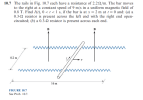 10.7 The rails in Fig. 10.7 each have a resistance of 2.2 S2/m. The bar moves to the night at a constant speed of 9 m/s in a uniform magnetic field of 0.8 T. Find I(t), 0 < t < 1 s, if the bar is at x 2 m at t = 0 and: (a) a 03-Ω resistor is present across the left end with the right end open- circuited; (b) a 0.3-2 resistor is present across each end....
In the figure below, a metal bar sitting on two parallel conducting rails, connected to each other by a resistor, is pulled to the right at a constant speed.
 A vertical bar and two parallel horizontal rails lie in the
plane of the page. The parallel rails run from left to right, with
one a distance ℓ above the other. The left ends of the rails are
connected by a vertical wire containing a resistor R. The
vertical bar lies across the rails to the right of the wire. Force
vector Fapp points from the bar toward
the right.In the figure below, a metal bar sitting on two parallel...
A vertical bar and two parallel horizontal rails lie in the
plane of the page. The parallel rails run from left to right, with
one a distance ℓ above the other. The left ends of the rails are
connected by a vertical wire containing a resistor R. The
vertical bar lies across the rails to the right of the wire. Force
vector Fapp points from the bar toward
the right.In the figure below, a metal bar sitting on two parallel...
A conducting bar moves along frictionless conducting rails connected to a 4.00 omega resistor. The length...
 A conducting bar moves along frictionless conducting rails
connected to a 4.00 omega resistor. The length of the bar is 1.60m
and a uniform magnetic field of 2.20T is applied perpendicular to
the paper pointing outward as shown
a) What is the applied force required to move the bar to the
right with a constant speed of 6.00 m/s?
b) At what rate is energy dissipated in the 4.00 ohm
resistor?
A conducting bar moves along frictionless conducting rails connected...
A conducting bar moves along frictionless conducting rails
connected to a 4.00 omega resistor. The length of the bar is 1.60m
and a uniform magnetic field of 2.20T is applied perpendicular to
the paper pointing outward as shown
a) What is the applied force required to move the bar to the
right with a constant speed of 6.00 m/s?
b) At what rate is energy dissipated in the 4.00 ohm
resistor?
A conducting bar moves along frictionless conducting rails connected...
A 0.204 m -long bar moves on parallel rails that are connected through a 6.05 Ω...
 A 0.204 m -long bar moves on parallel rails that are connected
through a 6.05 Ω resistor, as shown in the following figure (Figure
1), so the apparatus makes a complete circuit. You can ignore the
resistance of the bar and rails. The circuit is in a uniform
magnetic field 1.45 T that is directed into the plane of the
figure. At an instant when the induced current in the circuit is
counterclockwise and equal to 1.70 A , what...
A 0.204 m -long bar moves on parallel rails that are connected
through a 6.05 Ω resistor, as shown in the following figure (Figure
1), so the apparatus makes a complete circuit. You can ignore the
resistance of the bar and rails. The circuit is in a uniform
magnetic field 1.45 T that is directed into the plane of the
figure. At an instant when the induced current in the circuit is
counterclockwise and equal to 1.70 A , what...
A 0.282 m -long bar moves on parallel rails that are connected through a 6.03 Ω...
A 0.282 m -long bar moves on parallel rails that are connected through a 6.03 Ω resistor, as shown in the following figure (Figure 1), so the apparatus makes a complete circuit. You can ignore the resistance of the bar and rails. The circuit is in a uniform magnetic field 1.30 Tthat is directed into the plane of the figure. Part A At an instant when the induced current in the circuit is counterclockwise and equal to 1.85 A ,...
IP The figure shows a zero-resistance rod sliding to the right on two zero-resistance rails separated...
 IP The figure shows a zero-resistance rod sliding to the right on two zero-resistance rails separated by the distance L = 0.55 m (Figure 1). The rails are connected by a 13.2-2 resistor, and the entire system is in a uniform magnetic field with a magnitude of 0.810 T. Part A Find the speed at which the bar must be moved to produce a current of 0.130 A in the resistor. Express your answer using two significant figures. VO ALQ...
IP The figure shows a zero-resistance rod sliding to the right on two zero-resistance rails separated...
 IP The figure shows a zero-resistance rod sliding to the right on two zero-resistance rails separated by the distance L = 0.520 m (Figure 1). The rails are connected by a 12 3-22 resistor, and the entire system is in a uniform magnetic field with a magnitude of 0.775 T Figure 1 of 1 B . - • . O . . . OL . . Find the speed at which the bar must be moved to produce a current...
A zero resistance rod is sliding west along two zero resistance rails that are 2.3 m...
A zero resistance rod is sliding west along two zero resistance rails that are 2.3 m apart, on the ground where the earth’s magnetic field is nearly vertical with a magnitude of 0.60 mT. the bar is moving with a velocity 60 m/s. As it moves through the earth’s magnetic field an EMF is generated that creates a current flowing through the rails. a far away western resistance completes the circuit with a 5 Ω. What is voltage difference across...
The figure below shows a top view of a bar that can slide on two frictionless...
The figure below shows a top view of a bar that can slide on two frictionless rails. The resistor is R = 5.00 Ω, and a 2.50-T magnetic field is directed perpendicularly downward, into the page. Let ℓ = 1.20 m. A vertical bar and two parallel horizontal rails lie in the plane of the page, in a region of uniform magnetic field, vector Bin, pointing into the page. The parallel rails run from left to right, with one a...
w 2. The conducting bar illustrated in the figure moves on two frictionless, parallel rails in...
 w 2. The conducting bar illustrated in the figure moves on two frictionless, parallel rails in the presence of a uniform magnetic field directed into the page. The bar has mass m and its length is l. The bar is given an initial velocity Vi to the right and is released at t=0. Find the speed of the bar as a function of time after it is released.
 10.7 The rails in Fig. 10.7 each have a resistance of 2.2 S2/m. The bar moves to the night at a constant speed of 9 m/s in a uniform magnetic field of 0.8 T. Find I(t), 0 < t < 1 s, if the bar is at x 2 m at t = 0 and: (a) a 03-Ω resistor is present across the left end with the right end open- circuited; (b) a 0.3-2 resistor is present across each end....
 A vertical bar and two parallel horizontal rails lie in the
plane of the page. The parallel rails run from left to right, with
one a distance ℓ above the other. The left ends of the rails are
connected by a vertical wire containing a resistor R. The
vertical bar lies across the rails to the right of the wire. Force
vector Fapp points from the bar toward
the right.In the figure below, a metal bar sitting on two parallel...
A vertical bar and two parallel horizontal rails lie in the
plane of the page. The parallel rails run from left to right, with
one a distance ℓ above the other. The left ends of the rails are
connected by a vertical wire containing a resistor R. The
vertical bar lies across the rails to the right of the wire. Force
vector Fapp points from the bar toward
the right.In the figure below, a metal bar sitting on two parallel...
 A conducting bar moves along frictionless conducting rails
connected to a 4.00 omega resistor. The length of the bar is 1.60m
and a uniform magnetic field of 2.20T is applied perpendicular to
the paper pointing outward as shown
a) What is the applied force required to move the bar to the
right with a constant speed of 6.00 m/s?
b) At what rate is energy dissipated in the 4.00 ohm
resistor?
A conducting bar moves along frictionless conducting rails connected...
A conducting bar moves along frictionless conducting rails
connected to a 4.00 omega resistor. The length of the bar is 1.60m
and a uniform magnetic field of 2.20T is applied perpendicular to
the paper pointing outward as shown
a) What is the applied force required to move the bar to the
right with a constant speed of 6.00 m/s?
b) At what rate is energy dissipated in the 4.00 ohm
resistor?
A conducting bar moves along frictionless conducting rails connected...
 A 0.204 m -long bar moves on parallel rails that are connected
through a 6.05 Ω resistor, as shown in the following figure (Figure
1), so the apparatus makes a complete circuit. You can ignore the
resistance of the bar and rails. The circuit is in a uniform
magnetic field 1.45 T that is directed into the plane of the
figure. At an instant when the induced current in the circuit is
counterclockwise and equal to 1.70 A , what...
A 0.204 m -long bar moves on parallel rails that are connected
through a 6.05 Ω resistor, as shown in the following figure (Figure
1), so the apparatus makes a complete circuit. You can ignore the
resistance of the bar and rails. The circuit is in a uniform
magnetic field 1.45 T that is directed into the plane of the
figure. At an instant when the induced current in the circuit is
counterclockwise and equal to 1.70 A , what...
 IP The figure shows a zero-resistance rod sliding to the right on two zero-resistance rails separated by the distance L = 0.55 m (Figure 1). The rails are connected by a 13.2-2 resistor, and the entire system is in a uniform magnetic field with a magnitude of 0.810 T. Part A Find the speed at which the bar must be moved to produce a current of 0.130 A in the resistor. Express your answer using two significant figures. VO ALQ...
 IP The figure shows a zero-resistance rod sliding to the right on two zero-resistance rails separated by the distance L = 0.520 m (Figure 1). The rails are connected by a 12 3-22 resistor, and the entire system is in a uniform magnetic field with a magnitude of 0.775 T Figure 1 of 1 B . - • . O . . . OL . . Find the speed at which the bar must be moved to produce a current...
 w 2. The conducting bar illustrated in the figure moves on two frictionless, parallel rails in the presence of a uniform magnetic field directed into the page. The bar has mass m and its length is l. The bar is given an initial velocity Vi to the right and is released at t=0. Find the speed of the bar as a function of time after it is released.
Most questions answered within 3 hours.
-
Where is the error in this code sequence?
String s1 = "Hello";
String s2 = "ello";...
asked 11 months ago -
Financial data for Joel de Paris, Inc., for last year
follow:
Joel de Paris, Inc.
Balance...
asked 11 months ago -
Consider this reaction:
Al2(SO4)3 (aq)+ BaCl3
(aq) Al2Cl6 (aq)- +
3BaSO4(s) . What is the...
asked 11 months ago -
Suppose that Savneet is considering increasing her
recent random sample from 20 car rentals to 40...
asked 11 months ago -
Trucks arrive at an unloading terminal at an average rate of 120
per hour.
Trucks arrive...
asked 11 months ago -
Why are methanol and ethanol completely soluble in water while
octanol is not very little soluble....
asked 11 months ago -
A facilities manager at a university reads in a research report
that the mean amount of...
asked 11 months ago -
When the CuSO4 is rehydrated by adding water to the anhydrous
compound, is this an endothermic...
asked 11 months ago -
A ray of sunlight is passing from diamond into crown glass; the
angle of incidence is...
asked 11 months ago -
A block of mass 0.249 kg is placed on top of a light, vertical
spring of...
asked 11 months ago -
how do the kidneys compensate in the presences of acidosis
a) trigger hyperventilate
b) reserve acid...
asked 11 months ago -
Question 501 pts
The rental rate of capital to the firm increases. Which of the
following...
asked 11 months ago