What enzyme activities and DNAs are required to clone a fragment of mouse DNA?
What enzyme activities and DNAs are required to clone a fragment of mouse DNA?
Homework Answers
The things that would be required for mouse DNA cloning
1. Plasmid DNA where the mouse DNA needs to be cloned
2. Primer DNA oligos which helps in amplifying the region of interest from mouse DNA
3. Suitable restriction endonucleases that makes uniques cuts in the plasmid and at two ends of the amplifies DNA.
4. TaqDNA polymerase for PCR amplification of target DNA
5. DNA ligase for ligating the traget DNA into plasmid DNA.
Add Answer to:
What enzyme activities and DNAs are required to clone a fragment
of mouse DNA?
What enzyme activities and DNAs are required to clone a fragment of mouse DNA?
What enzyme activities and DNAs are required to clone a fragment of mouse DNA?
You are attempting to clone a 250-kb segment of mouse DNA in a yeast artificial chromosome....
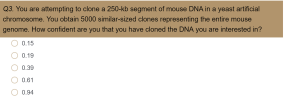 You are attempting to clone a 250-kb segment of mouse DNA in a yeast artificial chromosome. You obtain 5000 similar-sized clones representing the entire mouse genome. How confident are you that you have cloned the DNA you are interested in? 0.15 0.19 0.39 0.61 0.94
If a fragment produced by one enzyme disappears when the DNA is treated with that same...
If a fragment produced by one enzyme disappears when the DNA is treated with that same enzyme plus another enzyme, what does this signify?
You are preparing to clone a DNA fragment into a plasmid vector. You start by linearizing...
You are preparing to clone a DNA fragment into a plasmid vector. You start by linearizing your plasmid (concentration = 500 ng/μl) with EcoRI, which is provided in a standard 50% glycerol solution at 10 units/μl. Your enzyme also comes with an appropriate 10X reaction buffer. Taking into account the final allowable glycerol concentration, you want to add the maximum amount of EcoRI, to achieve complete digestion of 1 μg plasmid DNA in a total volume of 20 μl. Fill...
Suppose you want to sequence the following DNA segment: 5’-GATCTCTTGAAATG-primer site-3’ You clone the fragment into...
Suppose you want to sequence the following DNA segment: 5’-GATCTCTTGAAATG-primer site-3’ You clone the fragment into a plasmid, transform it into bacterial cells and isolate DNA from one of the bacterial colonies. You use the Sanger sequencing method to determine the sequence, separating the products from the sequencing reactions by gel electrophoresis. Draw the bands that should appear on the gel from the four sequencing reactions.
-Understand the concept of (restriction enzyme produced) DNA fragment separation by gel electrophoresis. -In gel electrophoresis,...
-Understand the concept of (restriction enzyme produced) DNA fragment separation by gel electrophoresis. -In gel electrophoresis, which DNA fragment (in terms of size) would migrate further from the sample well? -Understand restriction enzyme(s) and recognize they leave blunt or sticky ends (ie. XbaI, SmaI, EcoRI, BamHI)? -Understand the steps (process) of the Polymerase Chain Reaction and Thermal Cycling. Please answer as much as you can and I will give a high rate
If you cut the following single stranded DNA fragment with a restriction enzyme with restriction site...
If you cut the following single stranded DNA fragment with a restriction enzyme with restriction site of 5’GAATTC 3” and the cutting point between G and A. a. How many fragments you will get b. Specify the size (Number of bases) and the sequence of each fragment, pay attention to DNA direction (5’-3’) 5” ACATTGTCCGGGAATTC CGGGCTAGGCAT T GAATTGGAACA GAATTC GGGCCCGATCCGTA 3
you have heard about three different vectors to clone DNA fragments (plasmids, BACs, and YACs). Which...
you have heard about three different vectors to clone DNA fragments (plasmids, BACs, and YACs). Which of these would be most appropriate to clone a DNA fragment with the length of 5,000 bp, and which would be most appropriate for a fragment of 200,000 bp? The genome of fruit flies has a size of about 175 Mbp. Assuming that each base pair has a height of 3 Angstrom (1 Angstrom is 10^-10 m), how long is the genome of a...
Why do restriction enzymes need to be kept on ice? What order should the DNA, enzyme,...
Why do restriction enzymes need to be kept on ice? What order should the DNA, enzyme, water and buffer be added to the microcentrifuge tube for a restriction digest? If lambda DNA is linear, how many times would the enzyme have to cut the DNA to generate five DNA fragments? Would a shorter DNA fragment move faster or slower through the agarose gel than a longer fragment? Why?
YACs are used to clone large pieces of DNA in yeast cells. What three types of...
YACs are used to clone large pieces of DNA in yeast cells. What three types of DNA sequence are required to ensure proper replication and propagation of a YAC in a yeast cell, and what is the function of each?
 You are attempting to clone a 250-kb segment of mouse DNA in a yeast artificial chromosome. You obtain 5000 similar-sized clones representing the entire mouse genome. How confident are you that you have cloned the DNA you are interested in? 0.15 0.19 0.39 0.61 0.94
Most questions answered within 3 hours.
-
Where is the error in this code sequence?
String s1 = "Hello";
String s2 = "ello";...
asked 10 months ago -
Financial data for Joel de Paris, Inc., for last year
follow:
Joel de Paris, Inc.
Balance...
asked 10 months ago -
Consider this reaction:
Al2(SO4)3 (aq)+ BaCl3
(aq) Al2Cl6 (aq)- +
3BaSO4(s) . What is the...
asked 10 months ago -
Suppose that Savneet is considering increasing her
recent random sample from 20 car rentals to 40...
asked 10 months ago -
Trucks arrive at an unloading terminal at an average rate of 120
per hour.
Trucks arrive...
asked 10 months ago -
Why are methanol and ethanol completely soluble in water while
octanol is not very little soluble....
asked 10 months ago -
A facilities manager at a university reads in a research report
that the mean amount of...
asked 10 months ago -
When the CuSO4 is rehydrated by adding water to the anhydrous
compound, is this an endothermic...
asked 10 months ago -
A ray of sunlight is passing from diamond into crown glass; the
angle of incidence is...
asked 10 months ago -
A block of mass 0.249 kg is placed on top of a light, vertical
spring of...
asked 10 months ago -
how do the kidneys compensate in the presences of acidosis
a) trigger hyperventilate
b) reserve acid...
asked 10 months ago -
Question 501 pts
The rental rate of capital to the firm increases. Which of the
following...
asked 10 months ago