Which is true? A change in the first base of a codon is most likely to...
Which is true?
| A change in the first base of a codon is most likely to still code for the same amino acid |
| A change in the third base of a codon is most likely to still code for the same amino acid |
| A change in the second base of a codon is most likely to still code for the same amino acid |
Homework Answers
Answer: Correct answer is --- A change in the third base of codon is most likely to still code for the same amino acid.
Explanation: The amino acid differ only in the last base of triplet. Inspecting the codes for amino acids revealed that XYC and XYU always encodes for the same amino acid.
Add Answer to:
Which is true?
A change in the first base of a codon is most likely to...
For which codon(s) of isoleucine could a single base change account for an amino acid change...
For which codon(s) of isoleucine could a single base change account for an amino acid change to methionine? Select all that apply. Select all that apply. A. AUC B. AUU C. AUA D. AUG E.none of these codons
can you explain? Question 2 For which codon(s) could a single base change account for this...
 can you explain?
Question 2 For which codon(s) could a single base change account for this amino acid change? Leucine (Leu) to Histidine (His) UUG CUA VUA CUG None of these CUC CUU
can you explain?
Question 2 For which codon(s) could a single base change account for this amino acid change? Leucine (Leu) to Histidine (His) UUG CUA VUA CUG None of these CUC CUU
1. In a "silent" mutation A) The codon that mutates does not cause a change in...
1. In a "silent" mutation A) The codon that mutates does not cause a change in the amino acid specified B) The codon that mutates causes change in the amino acid specified C) The codon that mutates cause a stop codon to occur instead of the placement of an amino acid D) The mutation does not occur in a codon E) The mutation is not in DNA 2. In a "nonsense" mutation A) The codon that mutates does not cause...
4. A codon that specifies the amino acid Gly undergoes a single-base substitution to become a...
 4. A codon that specifies the amino acid Gly undergoes a single-base substitution to become a nonsense mutation. According to the genetic code, is this mutation a transition or a transversion? At which position of the codon does the mutation occur? 2 pts
Consider a mutation in which the codon CUU is changed to AUU. Which of the following...
Consider a mutation in which the codon CUU is changed to AUU. Which of the following statements is TRUE with respect to this codon change? options: The mutation is a nonsense mutation. The mutation is a transition mutation. One hydrophobic amino acid is replaced with another hydrophobic amino acid. The mutation is suppressor mutation.
Which one change would be most likely to decrease the deltaG of an enzyme-catalyzed reaction, according...
 Which one change would be most likely to decrease the deltaG of an enzyme-catalyzed reaction, according to our coverage? Use a version of the enzyme with a lower Kcat. Use a version of the enzyme with a lower Km. Find a way to remove product of the reaction (eg, by consuming that product in another reaction) Add a noncompetitive inhibitor. Double the enzyme concentration QUESTION 14 Think about an 800-amino acid polypeptide. In the middle (let's say amino acids 401-402)...
Second base UUU Phenylalanine Use ysteine Serine VVA Leucine news UGA Stop codon ( U G...
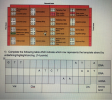 Second base UUU Phenylalanine Use ysteine Serine VVA Leucine news UGA Stop codon ( U G Tryptophan (Tepl VA Tyrosine (y VAA Stop codon UAG Stop codon EAN: Histidine (His) EA Glutamine (Gip CUU CUC Leuch CCU ICGU CGC eu Arginine (Arg) ICGA ICGG First base Third base soleu ACU ACC AAU A (Asht AG Serine Sen AGA Arginine (AIC) nine Meg: Lysine (Lys) GAU Aspartic GGU GUC Valine (Van) GAC AS GUA GUG 1) Complete the following table AND...
Which of the following amino acid changes could result from a mutation that changed a single...
Which of the following amino acid changes could result from a mutation that changed a single base? For each change that could result from the alteration of a single base, determine which position of the codon (first, second, or third nucleotide) in the mRNA must be altered for the change to result. a) Trp → Stop b) Ser → Phe c) Asp → Tyr d) Ile → Thr
1. Which repair mechanism is most likely affected if the enzyme DNA glycosylase is not functioning...
1. Which repair mechanism is most likely affected if the enzyme DNA glycosylase is not functioning properly? photoreactivation repair base excision repair SOS repair double-strand break repair nucleotide excision repair 2. In bacteria and eukaryotes, a mutation is when ________. In bacteria and eukaryotes, a mutation is when ________. A.the nucleotide sequence in an mRNA molecule is directly changed B.the nucleotide sequence in a DNA molecule is directly changed C.the amino acid sequence in a protein molecule is directly changed...
Place the following mutations, all within the same codon in the open reading frame of a...
Place the following mutations, all within the same codon in the open reading frame of a gene, in order from MOST likely to LEAST likely to eliminate the function of the encoded protein. A. A transition mutation in the second position of the codon. B. A transversion mutation in the third position of the codon. C. A transition mutation in the third position of the codon. D. A deletion of one base from the third position of the codon Be...
 can you explain?
Question 2 For which codon(s) could a single base change account for this amino acid change? Leucine (Leu) to Histidine (His) UUG CUA VUA CUG None of these CUC CUU
can you explain?
Question 2 For which codon(s) could a single base change account for this amino acid change? Leucine (Leu) to Histidine (His) UUG CUA VUA CUG None of these CUC CUU
 4. A codon that specifies the amino acid Gly undergoes a single-base substitution to become a nonsense mutation. According to the genetic code, is this mutation a transition or a transversion? At which position of the codon does the mutation occur? 2 pts
 Which one change would be most likely to decrease the deltaG of an enzyme-catalyzed reaction, according to our coverage? Use a version of the enzyme with a lower Kcat. Use a version of the enzyme with a lower Km. Find a way to remove product of the reaction (eg, by consuming that product in another reaction) Add a noncompetitive inhibitor. Double the enzyme concentration QUESTION 14 Think about an 800-amino acid polypeptide. In the middle (let's say amino acids 401-402)...
 Second base UUU Phenylalanine Use ysteine Serine VVA Leucine news UGA Stop codon ( U G Tryptophan (Tepl VA Tyrosine (y VAA Stop codon UAG Stop codon EAN: Histidine (His) EA Glutamine (Gip CUU CUC Leuch CCU ICGU CGC eu Arginine (Arg) ICGA ICGG First base Third base soleu ACU ACC AAU A (Asht AG Serine Sen AGA Arginine (AIC) nine Meg: Lysine (Lys) GAU Aspartic GGU GUC Valine (Van) GAC AS GUA GUG 1) Complete the following table AND...
Most questions answered within 3 hours.
-
Where is the error in this code sequence?
String s1 = "Hello";
String s2 = "ello";...
asked 11 months ago -
Financial data for Joel de Paris, Inc., for last year
follow:
Joel de Paris, Inc.
Balance...
asked 11 months ago -
Consider this reaction:
Al2(SO4)3 (aq)+ BaCl3
(aq) Al2Cl6 (aq)- +
3BaSO4(s) . What is the...
asked 11 months ago -
Suppose that Savneet is considering increasing her
recent random sample from 20 car rentals to 40...
asked 11 months ago -
Trucks arrive at an unloading terminal at an average rate of 120
per hour.
Trucks arrive...
asked 11 months ago -
Why are methanol and ethanol completely soluble in water while
octanol is not very little soluble....
asked 11 months ago -
A facilities manager at a university reads in a research report
that the mean amount of...
asked 11 months ago -
When the CuSO4 is rehydrated by adding water to the anhydrous
compound, is this an endothermic...
asked 11 months ago -
A ray of sunlight is passing from diamond into crown glass; the
angle of incidence is...
asked 11 months ago -
A block of mass 0.249 kg is placed on top of a light, vertical
spring of...
asked 11 months ago -
how do the kidneys compensate in the presences of acidosis
a) trigger hyperventilate
b) reserve acid...
asked 11 months ago -
Question 501 pts
The rental rate of capital to the firm increases. Which of the
following...
asked 11 months ago