Draw and label the essential components of a DNA replication fork. Pay close attention to DNA...
Draw and label the essential components of a DNA replication fork. Pay close attention to DNA strand polarity.
Homework Answers

Add Answer to:
Draw and label the essential components of a DNA replication
fork. Pay close attention to DNA...
2. Draw replication fork, and place and label the following -DNA being copied (template)-new D -...
 2. Draw replication fork, and place and label the following -DNA being copied (template)-new D - Correct 5' and 3' markings NA-helicase -primaseleading strand and Okazaki fragments
5a. For the replication fork shown below: - label the leading and lagging strands; - draw...
 5a. For the replication fork shown below: - label the leading and lagging strands; - draw arrows to indicate which direction DNA synthesis is proceeding in for each of these strands; - label their 5' and 3' ends. Replication fork movement →→→ 5'-ATCTGGCAGTACGTACTGGATC CGUCAUGC GTCGAATCTGAC-3' CAGCTTAGACTG-5' ATCTGGCTATTCGT 3'-TAGACCGATAAGCATGACCTAG b. Okazaki fragments are generated during (leading / lagging) strand synthesis (circle the correct answer). c. Some U's are included in one of the strands in the figure. Why are there U's...
QUESTION 3 Replication Now DNA Origin of replication DOC Replication fork B CON RO Unreplicated DNA...
 QUESTION 3 Replication Now DNA Origin of replication DOC Replication fork B CON RO Unreplicated DNA Prokaryotic DNA The above diagram shows DNA replication in bacterial cells. An antibody specific only to DNA polymerase I was added to DNA undergoing replication in bacterial cells. Which of the following statements are CORRECT? a. There would be a higher concentration of antibodies on the leading strands of replication foris A and B and a lower concentration of antibodies on the lagging strands...
Describe the process of DNA replication. (Your answer should include the following: replication fork, semiconservative replication,...
Describe the process of DNA replication. (Your answer should include the following: replication fork, semiconservative replication, replication fork, DNA gyrase, helicase, primase, DNA polymerase, DNA ligase, leading strand, lagging strand, continuous replication, non-continuous replication, and Okazaki fragment)
what property allows the leading strand of the replication fork to proceed more rapidly than the...
 what property allows the leading strand of the
replication fork to proceed more rapidly than the lagging
strand?
A) the DNA unwinds more rapidly
B) fewer nucleosomes to remove
C)greater helices activity
D) polarity of the template DNA
QUESTION 39 What property allows the leading strand of the replication fork to proceed more rapidly than the lagging strand? le DNA unwinds more rapidly fewer nucleosomes to remove greater helicase activity polarity of the template DNA
what property allows the leading strand of the
replication fork to proceed more rapidly than the lagging
strand?
A) the DNA unwinds more rapidly
B) fewer nucleosomes to remove
C)greater helices activity
D) polarity of the template DNA
QUESTION 39 What property allows the leading strand of the replication fork to proceed more rapidly than the lagging strand? le DNA unwinds more rapidly fewer nucleosomes to remove greater helicase activity polarity of the template DNA
DNA Replication. Sketch a replication fork of bacterial DNA in which one strand is being replicated...
 DNA Replication. Sketch a replication fork of bacterial DNA in which one strand is being replicated discontinuously and the other is being replicated continuously. List six different enzyme activities associated with the replication process, identity the function of each activity, and show where each would be located on the replication fork. In addition, identify the following features on your sketch: DNA template, RNA primer, Okazaki fragments, and single-stranded DNA binding protein.
A) Explain lagging strand DNA replication in detail. Underline the following terms in your answer: replication...
A) Explain lagging strand DNA replication in detail. Underline the following terms in your answer: replication fork, DNA polymerase III, primase, and ligation. Make sure that your answer is complete and that all the entities that come together in the process of lagging strand replication are clearly explained. Draw one figure of a replication fork with the polarity (directionality) of each DNA strand indicated. G) Explain RNA transcription in E. coli in detail, from initiation to termination. Underline the following...
Formation of a replication fork results in: A. continuous synthesis of DNA on the lagging strand....
Formation of a replication fork results in: A. continuous synthesis of DNA on the lagging strand. B. supercoiling in the parental DNA ahead of the fork. C. of new 3' -OH regions on the template DNA. D. binding of SSB protein on the double-stranded parental DNA. E. All of the above occur when the replication fork is formed.
The image shows a replication fork, template DNA strands, and new DNA strands. Label the image...
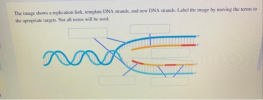 The image shows a replication fork, template DNA strands, and new DNA strands. Label the image by moving the terms to the apropriate targets. Not all terms will be used.
The following is an image of a section of dna. if a replication fork is moving...
The following is an image of a section of dna. if a replication fork is moving from right to left, which strand (top or Bottom) is the template strand for the leading strand. 3' AAATCGCGATCGATGGTCTGAGTTTGAATC 5' 5' TTTAGCGCTAGCTACCAGACTCAAACTTAG 3'
 2. Draw replication fork, and place and label the following -DNA being copied (template)-new D - Correct 5' and 3' markings NA-helicase -primaseleading strand and Okazaki fragments
 5a. For the replication fork shown below: - label the leading and lagging strands; - draw arrows to indicate which direction DNA synthesis is proceeding in for each of these strands; - label their 5' and 3' ends. Replication fork movement →→→ 5'-ATCTGGCAGTACGTACTGGATC CGUCAUGC GTCGAATCTGAC-3' CAGCTTAGACTG-5' ATCTGGCTATTCGT 3'-TAGACCGATAAGCATGACCTAG b. Okazaki fragments are generated during (leading / lagging) strand synthesis (circle the correct answer). c. Some U's are included in one of the strands in the figure. Why are there U's...
 QUESTION 3 Replication Now DNA Origin of replication DOC Replication fork B CON RO Unreplicated DNA Prokaryotic DNA The above diagram shows DNA replication in bacterial cells. An antibody specific only to DNA polymerase I was added to DNA undergoing replication in bacterial cells. Which of the following statements are CORRECT? a. There would be a higher concentration of antibodies on the leading strands of replication foris A and B and a lower concentration of antibodies on the lagging strands...
 what property allows the leading strand of the
replication fork to proceed more rapidly than the lagging
strand?
A) the DNA unwinds more rapidly
B) fewer nucleosomes to remove
C)greater helices activity
D) polarity of the template DNA
QUESTION 39 What property allows the leading strand of the replication fork to proceed more rapidly than the lagging strand? le DNA unwinds more rapidly fewer nucleosomes to remove greater helicase activity polarity of the template DNA
what property allows the leading strand of the
replication fork to proceed more rapidly than the lagging
strand?
A) the DNA unwinds more rapidly
B) fewer nucleosomes to remove
C)greater helices activity
D) polarity of the template DNA
QUESTION 39 What property allows the leading strand of the replication fork to proceed more rapidly than the lagging strand? le DNA unwinds more rapidly fewer nucleosomes to remove greater helicase activity polarity of the template DNA
 DNA Replication. Sketch a replication fork of bacterial DNA in which one strand is being replicated discontinuously and the other is being replicated continuously. List six different enzyme activities associated with the replication process, identity the function of each activity, and show where each would be located on the replication fork. In addition, identify the following features on your sketch: DNA template, RNA primer, Okazaki fragments, and single-stranded DNA binding protein.
 The image shows a replication fork, template DNA strands, and new DNA strands. Label the image by moving the terms to the apropriate targets. Not all terms will be used.
Most questions answered within 3 hours.
-
Where is the error in this code sequence?
String s1 = "Hello";
String s2 = "ello";...
asked 10 months ago -
Financial data for Joel de Paris, Inc., for last year
follow:
Joel de Paris, Inc.
Balance...
asked 10 months ago -
Consider this reaction:
Al2(SO4)3 (aq)+ BaCl3
(aq) Al2Cl6 (aq)- +
3BaSO4(s) . What is the...
asked 10 months ago -
Suppose that Savneet is considering increasing her
recent random sample from 20 car rentals to 40...
asked 10 months ago -
Trucks arrive at an unloading terminal at an average rate of 120
per hour.
Trucks arrive...
asked 10 months ago -
Why are methanol and ethanol completely soluble in water while
octanol is not very little soluble....
asked 10 months ago -
A facilities manager at a university reads in a research report
that the mean amount of...
asked 10 months ago -
When the CuSO4 is rehydrated by adding water to the anhydrous
compound, is this an endothermic...
asked 10 months ago -
A ray of sunlight is passing from diamond into crown glass; the
angle of incidence is...
asked 10 months ago -
A block of mass 0.249 kg is placed on top of a light, vertical
spring of...
asked 10 months ago -
how do the kidneys compensate in the presences of acidosis
a) trigger hyperventilate
b) reserve acid...
asked 10 months ago -
Question 501 pts
The rental rate of capital to the firm increases. Which of the
following...
asked 10 months ago