Assume that you have cut λ DNA with the restriction enzyme HindIII. You separate the fragments...
Assume that you have cut λ DNA with the restriction enzyme
HindIII. You separate the fragments on an agarose gel and stain the
DNA with ethidium bromide. You notice that the intensity of the
stain is less in the bands that have migrated closer to the "+"
pole. Give an explanation for this finding.
Homework Answers
 DNA is used for
the digestion with the restriction enzyme HindIII to generate
different DNA fragments of different sizes that move on the agarose
gel electrophoresis band from the negative terminal towards the
positive terminal of the gel. The smaller fragments move towards
faster towards the + terminal of the agarose apparatus gel whereas
the larger size bands in the electrophoresis gel assembly buffer
system move at a slower velocity. The smaller size fragments bind
to the ethidium bromide with less intensity as the number of the
binding sites of the stain are less in the smaller size bands that
have migrated closer to the + pole. Therefore, the intensity of the
smaller bands after visualization on the agarose gel under the UV
transilluminator appears to be of lower intensity as compared to
the illumination intensity of the larger size bands on the gel.
DNA is used for
the digestion with the restriction enzyme HindIII to generate
different DNA fragments of different sizes that move on the agarose
gel electrophoresis band from the negative terminal towards the
positive terminal of the gel. The smaller fragments move towards
faster towards the + terminal of the agarose apparatus gel whereas
the larger size bands in the electrophoresis gel assembly buffer
system move at a slower velocity. The smaller size fragments bind
to the ethidium bromide with less intensity as the number of the
binding sites of the stain are less in the smaller size bands that
have migrated closer to the + pole. Therefore, the intensity of the
smaller bands after visualization on the agarose gel under the UV
transilluminator appears to be of lower intensity as compared to
the illumination intensity of the larger size bands on the gel.
Add Answer to:
Assume that you have cut λ DNA with the restriction enzyme
HindIII. You separate the fragments...
You have determined that a bacterial strain you are working with contains a single type of...
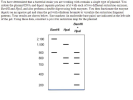 You have determined that a bacterial strain you are working with
contains a single type of plasmid. You isolate the plasmid DNA and
digest separate portions of it with each of two different
restriction enzymes, BamHI and HpaI, and also perform a double
digest using both enzymes. You then fractionate the enzyme digests
on an agarose gel and stain the gel with ethidium bromideto
visualize the restriction fragment patterns. Your results are shown
below. Size markers (in nucleotide base pairs)...
You have determined that a bacterial strain you are working with
contains a single type of plasmid. You isolate the plasmid DNA and
digest separate portions of it with each of two different
restriction enzymes, BamHI and HpaI, and also perform a double
digest using both enzymes. You then fractionate the enzyme digests
on an agarose gel and stain the gel with ethidium bromideto
visualize the restriction fragment patterns. Your results are shown
below. Size markers (in nucleotide base pairs)...
An 9 kb circular plasmid is cut with the EcoRI restriction enzyme, and the reaction products...
An 9 kb circular plasmid is cut with the EcoRI restriction enzyme, and the reaction products are run on a DNA gel and stained with ethidium bromide. Bands of 1, 3 and 5 kb are seen. How many EcoRI sites are in the plasmid? Choose the one answer that is most correct. Group of answer choices: At least 2, At least 3, At least 5, None, At least 1, At least 4
Why do restriction enzymes need to be kept on ice? What order should the DNA, enzyme,...
Why do restriction enzymes need to be kept on ice? What order should the DNA, enzyme, water and buffer be added to the microcentrifuge tube for a restriction digest? If lambda DNA is linear, how many times would the enzyme have to cut the DNA to generate five DNA fragments? Would a shorter DNA fragment move faster or slower through the agarose gel than a longer fragment? Why?
1. If a restriction enzyme cuts a circular plasmid twice, how many fragments would you see...
1. If a restriction enzyme cuts a circular plasmid twice, how many fragments would you see on the gel? 2. How would you estimate the total number of base pairs in a plasmid by looking at the DNA fragments of the digested plasmid on a gel? 3. If a linear 1kb DNA fragment has a restriction site that is located 50 bp from one end of the plasmid, what would you expect to see if the digested and undigested DNA...
A restriction map lists the locations of DNA sequences that are cut by a particular restriction...
 A restriction map lists the
locations of DNA sequences that are cut by a particular restriction
enzyme for a piece of DNA, such as a chromosome or a plasmid.
Restriction maps are important when generating a construct for
experimental use. Digesting the DNA sequence with the restriction
enzymes will result in fragmented DNA of predictable sizes, based
on the restriction map, that allow a researcher to analyze if his
or her construct was generated correctly when visualized using gel
electrophoresis....
A restriction map lists the
locations of DNA sequences that are cut by a particular restriction
enzyme for a piece of DNA, such as a chromosome or a plasmid.
Restriction maps are important when generating a construct for
experimental use. Digesting the DNA sequence with the restriction
enzymes will result in fragmented DNA of predictable sizes, based
on the restriction map, that allow a researcher to analyze if his
or her construct was generated correctly when visualized using gel
electrophoresis....
NA fingerprinting uses a process called gel electrophoresis to separate the fragments of DNA. Once the...
NA fingerprinting uses a process called gel electrophoresis to separate the fragments of DNA. Once the DNA fragments are sorted, the pattern of bands can be analyzed. 1)Gel Electrophoresis Procedure The smaller DNA fragments start to move away from the wells and the larger DNA fragments remain closer to the wells. 2)An electric current is passed through the gel. 3) DNA fragments are treated with a dye. 4)A restriction endonuclease is added to the DNA. 5)Using micropipettes, the DNA samples...
A linear piece of DNA has the following restrictions sites: You decided to set up an...
 A linear piece of DNA has the following restrictions sites:
You decided to set up an experiment where you added one of these
restriction enzymes to this DNA. After this DNA was digested with
that restriction enzyme, you separated the resulting fragment(s)
using agarose electrophoresis. After the gel was stained with
ethidium bromide, you observed the following gel (the DNA ladder is
your reference standard and is comprised of a series of DNA
fragments of known length).
a) Which restriction...
A linear piece of DNA has the following restrictions sites:
You decided to set up an experiment where you added one of these
restriction enzymes to this DNA. After this DNA was digested with
that restriction enzyme, you separated the resulting fragment(s)
using agarose electrophoresis. After the gel was stained with
ethidium bromide, you observed the following gel (the DNA ladder is
your reference standard and is comprised of a series of DNA
fragments of known length).
a) Which restriction...
Luestion 3 1 pts Review: You have the DNA that is radioactively labeled at the S'ends...
 Luestion 3 1 pts Review: You have the DNA that is radioactively labeled at the S'ends of DNA as shown below. But you want DNA that is labeled only at one end of the DNA, not both ends. One of the other undergraduate students in the lab suggests that you use a restriction enzyme to cut the DNA, then electrophorese the DNA in an agarose gel, then cut out the region of the gel with radioactive DNA fragment you want,...
If you cut the following single stranded DNA fragment with a restriction enzyme with restriction site...
If you cut the following single stranded DNA fragment with a restriction enzyme with restriction site of 5’GAATTC 3” and the cutting point between G and A. a. How many fragments you will get b. Specify the size (Number of bases) and the sequence of each fragment, pay attention to DNA direction (5’-3’) 5” ACATTGTCCGGGAATTC CGGGCTAGGCAT T GAATTGGAACA GAATTC GGGCCCGATCCGTA 3
The picture above represents an agarose gel that was used to analyze plasmid DNA after it...
 The picture above represents an agarose gel that was used to analyze plasmid DNA after it was cut with the restriction enzyme HindIll. The plasmid was incubated with Hindill until all of the available Hindlll cut sites were cut by HindIll. After running the sample on the gel, three bands were detected (Note that there are three wells shown at the top of the gel for loading samples, however, only the middle well was loaded with sample). Based on this...
 You have determined that a bacterial strain you are working with
contains a single type of plasmid. You isolate the plasmid DNA and
digest separate portions of it with each of two different
restriction enzymes, BamHI and HpaI, and also perform a double
digest using both enzymes. You then fractionate the enzyme digests
on an agarose gel and stain the gel with ethidium bromideto
visualize the restriction fragment patterns. Your results are shown
below. Size markers (in nucleotide base pairs)...
You have determined that a bacterial strain you are working with
contains a single type of plasmid. You isolate the plasmid DNA and
digest separate portions of it with each of two different
restriction enzymes, BamHI and HpaI, and also perform a double
digest using both enzymes. You then fractionate the enzyme digests
on an agarose gel and stain the gel with ethidium bromideto
visualize the restriction fragment patterns. Your results are shown
below. Size markers (in nucleotide base pairs)...
 A restriction map lists the
locations of DNA sequences that are cut by a particular restriction
enzyme for a piece of DNA, such as a chromosome or a plasmid.
Restriction maps are important when generating a construct for
experimental use. Digesting the DNA sequence with the restriction
enzymes will result in fragmented DNA of predictable sizes, based
on the restriction map, that allow a researcher to analyze if his
or her construct was generated correctly when visualized using gel
electrophoresis....
A restriction map lists the
locations of DNA sequences that are cut by a particular restriction
enzyme for a piece of DNA, such as a chromosome or a plasmid.
Restriction maps are important when generating a construct for
experimental use. Digesting the DNA sequence with the restriction
enzymes will result in fragmented DNA of predictable sizes, based
on the restriction map, that allow a researcher to analyze if his
or her construct was generated correctly when visualized using gel
electrophoresis....
 A linear piece of DNA has the following restrictions sites:
You decided to set up an experiment where you added one of these
restriction enzymes to this DNA. After this DNA was digested with
that restriction enzyme, you separated the resulting fragment(s)
using agarose electrophoresis. After the gel was stained with
ethidium bromide, you observed the following gel (the DNA ladder is
your reference standard and is comprised of a series of DNA
fragments of known length).
a) Which restriction...
A linear piece of DNA has the following restrictions sites:
You decided to set up an experiment where you added one of these
restriction enzymes to this DNA. After this DNA was digested with
that restriction enzyme, you separated the resulting fragment(s)
using agarose electrophoresis. After the gel was stained with
ethidium bromide, you observed the following gel (the DNA ladder is
your reference standard and is comprised of a series of DNA
fragments of known length).
a) Which restriction...
 Luestion 3 1 pts Review: You have the DNA that is radioactively labeled at the S'ends of DNA as shown below. But you want DNA that is labeled only at one end of the DNA, not both ends. One of the other undergraduate students in the lab suggests that you use a restriction enzyme to cut the DNA, then electrophorese the DNA in an agarose gel, then cut out the region of the gel with radioactive DNA fragment you want,...
 The picture above represents an agarose gel that was used to analyze plasmid DNA after it was cut with the restriction enzyme HindIll. The plasmid was incubated with Hindill until all of the available Hindlll cut sites were cut by HindIll. After running the sample on the gel, three bands were detected (Note that there are three wells shown at the top of the gel for loading samples, however, only the middle well was loaded with sample). Based on this...
Most questions answered within 3 hours.
-
Where is the error in this code sequence?
String s1 = "Hello";
String s2 = "ello";...
asked 11 months ago -
Financial data for Joel de Paris, Inc., for last year
follow:
Joel de Paris, Inc.
Balance...
asked 11 months ago -
Consider this reaction:
Al2(SO4)3 (aq)+ BaCl3
(aq) Al2Cl6 (aq)- +
3BaSO4(s) . What is the...
asked 11 months ago -
Suppose that Savneet is considering increasing her
recent random sample from 20 car rentals to 40...
asked 11 months ago -
Trucks arrive at an unloading terminal at an average rate of 120
per hour.
Trucks arrive...
asked 11 months ago -
Why are methanol and ethanol completely soluble in water while
octanol is not very little soluble....
asked 11 months ago -
A facilities manager at a university reads in a research report
that the mean amount of...
asked 11 months ago -
When the CuSO4 is rehydrated by adding water to the anhydrous
compound, is this an endothermic...
asked 11 months ago -
A ray of sunlight is passing from diamond into crown glass; the
angle of incidence is...
asked 11 months ago -
A block of mass 0.249 kg is placed on top of a light, vertical
spring of...
asked 11 months ago -
how do the kidneys compensate in the presences of acidosis
a) trigger hyperventilate
b) reserve acid...
asked 11 months ago -
Question 501 pts
The rental rate of capital to the firm increases. Which of the
following...
asked 11 months ago