The following is a small part of a vector DNA sequence showing the NdeI and SacII cut sites. The bases recognizedby the enzymes are in bold. They both are Class II restriction enzymes. These enzymes recognize a specific sequence of palindromic bases, i.e., reads the same on both strands

1. When you cut this DNA, shown in the figure above, by NdeI, it will generate sticky ends. Write the two pieces of DNA that will result after NdeI digestion and underline the overhangs.
2. When you cut this DNA, shown in the figure above, by SacII, it will generate sticky ends. Write the two pieces of DNA that will result after SacII digestion and underline the overhangs.
3. After NdeI digestion as shown above in ‘A’, the DNA fragments are treated with Klenow fragment. Write the two pieces of DNA that will result after reactions with Klenow fragment.
4. After SacII digestion as shown above in ‘B’, the DNA fragments are treated with Klenow fragment. Write the two pieces of DNA that will result after reactions with Klenow fragment.
Homework Answers
Answer has been attached below as image. Hope this will help


Add Answer to:
The following is a small part of a vector DNA sequence showing
the NdeI and SacII...
find the errors Restriction enzymes recognize specific DNA sequences and cut each strand of DNA at...
 find the errors
Restriction enzymes recognize specific DNA sequences and cut each strand of DNA at specific locations at the target sequence. The result of digesting a particular genome with a particular restriction enzyme is a collection of restriction fragments of defined length and composition. These can be used to generate restriction maps or create pieces with sticky ends. These sticky ends can be used to attach to other fragments that have sticky ends caused by cutting with a different...
find the errors
Restriction enzymes recognize specific DNA sequences and cut each strand of DNA at specific locations at the target sequence. The result of digesting a particular genome with a particular restriction enzyme is a collection of restriction fragments of defined length and composition. These can be used to generate restriction maps or create pieces with sticky ends. These sticky ends can be used to attach to other fragments that have sticky ends caused by cutting with a different...
EcoRI is a common restriction enzyme used in cloning experiments. Its restriction sequence is G’AATTC. The...
EcoRI is a common restriction enzyme used in cloning experiments. Its restriction sequence is G’AATTC. The strand is cut at the position of the apostrophe. The 50 base pair sequence shown below contains one or more EcoRI sites. Find them and circle them. Then count the resulting size (in base pairs – bp) of the DNA fragments (pieces) left over after using EcoRI to cut this DNA sequence. Circle the EcoRI sites in the sequence below. 1- ggagaattcgctgtacgaggttaaccccgatgccATGGCATGAATTCGTG -50 List...
RECOMBINANT DNA: PLASMID VECTOR engineering is the direct manipulation of an organism's DNA using nology. To...
 RECOMBINANT DNA: PLASMID VECTOR engineering is the direct manipulation of an organism's DNA using nology. To begin the recombinant DNA process, scientists must first ide at codes for the production of the protein they want to manufacture. One is to go backwards from the amino acid sequence of the desired protein to ide sequence of the gene. After scientists have identified the gene, they m it. Restriction enzymes or endonucleases from bacterial cells are key in th ia produce restriction...
2. 3. Give the recognition sequence for the restriction enzyme Eael in a dsDNA sequence, indicate...
 2. 3. Give the recognition sequence for the restriction enzyme Eael in a dsDNA sequence, indicate the cleavage sites. (2) With reference to your PCR amplicon, detail the terminal DNA sequences at the two ends of the fragment that will be generated after digestion with Eael (indicate these in the two blocks below). What type of ends are generated by this enzyme (blunt/sticky, 5' or 3' overhang)? PCR amplicon بیا بیا
One strand of a DNA sequences is given below. Find the EcoRI sites and indicate the...
 One strand of a DNA sequences is given below. Find the
EcoRI sites and indicate the cutting site with an arrow. Count the
number of bases in each fragment.
CP22: vne strand of a DNA sequence is given below. Find the EcoRI sites and indicate the cutting site with an arrow. Count the number of bases in each fragment. Restriction digest A: ATTGAATTCCGGTTAGCTTTAGAATTCCGCCATATGCGCAATTGGAATTCC Number of bases in each fragment: Now compare the same region of DNA from another individual. Where...
One strand of a DNA sequences is given below. Find the
EcoRI sites and indicate the cutting site with an arrow. Count the
number of bases in each fragment.
CP22: vne strand of a DNA sequence is given below. Find the EcoRI sites and indicate the cutting site with an arrow. Count the number of bases in each fragment. Restriction digest A: ATTGAATTCCGGTTAGCTTTAGAATTCCGCCATATGCGCAATTGGAATTCC Number of bases in each fragment: Now compare the same region of DNA from another individual. Where...
RESTRICTION DIGEST ANALYSIS QUESTIONS(true or yes = A: false or no = b) 1. Larger DNA...
 RESTRICTION DIGEST ANALYSIS QUESTIONS(true or yes = A: false or no = b) 1. Larger DNA fragments appear near the bottom of the gel. 2. Larger DNA fragments move more rapidly through the gel. D ONA that has many restriction sites for a certain endonuclease will be cut into more fragmets than DNA with fewer restriction sites. 4. Cutting DNA with many different endonucleases will result in more DNA fragments. 5. Restriction enzymes all recognize the same base sequence when...
A1. The following is the DNA sequence of a hypothetical gene for the SMALL protein. It...
 A1. The following is the DNA sequence of a hypothetical gene for the SMALL protein. It is called the SMALL gene. i atgggattac actgtcacga ccaaatagcc ttcattgtat 41 caaaaggato aatcgagtta tag Imagine you are doing a research project in a laboratory and your supervisor asks you to clone the SMALL gene into the PBR322 plasmid (shown below). You must use the Pstl and EcoRI sites for your cloning. HindIII EcoRI | EcoRV BamHI 4359 0 29 185 4000 375 Sall Psti...
Write a concept map with the following terms. DNA Complementarity of bases Antiparallel Semiconservative replication Origin...
Write a concept map with the following terms. DNA Complementarity of bases Antiparallel Semiconservative replication Origin of replication Replication fork Helicase SSBP Topoisomerase RNA Primase Polymerization proceeds 5’ to 3’ DNA polymerase Leading strand Lagging strand Okasaki fragments DNA ligase Bidirectional replication Telomeres Telomerase PCR Gel electrophoresis Restriction enzymes Palindromic sequence Southern blots Sanger dideoxy sequencing Genetic engineering Recombinant DNA Transgenic Organism GMOs
Suppose you digest the genomic DNA of a particular organism with the restriction enzyme SauA. Then...
 Suppose you digest the genomic DNA of a particular organism with
the restriction enzyme SauA. Then you ligate the resulting fragment
into a unique BamHI cloning site of a plasmid. The sequence of the
restriction sites and position of cleavage is shown below
Note: X and Y and their complementary bases Z and Y’
respectively can be any base (A,C, G, or T)
1) As you can see, ligation is possible because the two restriction
enzymes produce compatible sticky ends....
Suppose you digest the genomic DNA of a particular organism with
the restriction enzyme SauA. Then you ligate the resulting fragment
into a unique BamHI cloning site of a plasmid. The sequence of the
restriction sites and position of cleavage is shown below
Note: X and Y and their complementary bases Z and Y’
respectively can be any base (A,C, G, or T)
1) As you can see, ligation is possible because the two restriction
enzymes produce compatible sticky ends....
7. The following DNA sequence is from a virus that is dangerous and scientists want to...
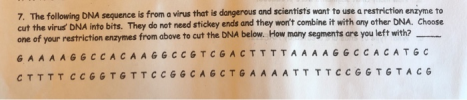 7. The following DNA sequence is from a virus that is dangerous and scientists want to use a restriction enzyme to cut the virus DNA into bits. They do not need stickey ends and they won't combine it with any other DNA. Choose one of your restriction enzymes from above to cut the DNA below. How many segments are you left with? 6AAAAG6ccACAA66ссетсАсттттAAAA66ссАсАтес сттттcc66теттcc66 CA6 ст. ААААТт тТcc66 TGTAc6
 find the errors
Restriction enzymes recognize specific DNA sequences and cut each strand of DNA at specific locations at the target sequence. The result of digesting a particular genome with a particular restriction enzyme is a collection of restriction fragments of defined length and composition. These can be used to generate restriction maps or create pieces with sticky ends. These sticky ends can be used to attach to other fragments that have sticky ends caused by cutting with a different...
find the errors
Restriction enzymes recognize specific DNA sequences and cut each strand of DNA at specific locations at the target sequence. The result of digesting a particular genome with a particular restriction enzyme is a collection of restriction fragments of defined length and composition. These can be used to generate restriction maps or create pieces with sticky ends. These sticky ends can be used to attach to other fragments that have sticky ends caused by cutting with a different...
 RECOMBINANT DNA: PLASMID VECTOR engineering is the direct manipulation of an organism's DNA using nology. To begin the recombinant DNA process, scientists must first ide at codes for the production of the protein they want to manufacture. One is to go backwards from the amino acid sequence of the desired protein to ide sequence of the gene. After scientists have identified the gene, they m it. Restriction enzymes or endonucleases from bacterial cells are key in th ia produce restriction...
 2. 3. Give the recognition sequence for the restriction enzyme Eael in a dsDNA sequence, indicate the cleavage sites. (2) With reference to your PCR amplicon, detail the terminal DNA sequences at the two ends of the fragment that will be generated after digestion with Eael (indicate these in the two blocks below). What type of ends are generated by this enzyme (blunt/sticky, 5' or 3' overhang)? PCR amplicon بیا بیا
 One strand of a DNA sequences is given below. Find the
EcoRI sites and indicate the cutting site with an arrow. Count the
number of bases in each fragment.
CP22: vne strand of a DNA sequence is given below. Find the EcoRI sites and indicate the cutting site with an arrow. Count the number of bases in each fragment. Restriction digest A: ATTGAATTCCGGTTAGCTTTAGAATTCCGCCATATGCGCAATTGGAATTCC Number of bases in each fragment: Now compare the same region of DNA from another individual. Where...
One strand of a DNA sequences is given below. Find the
EcoRI sites and indicate the cutting site with an arrow. Count the
number of bases in each fragment.
CP22: vne strand of a DNA sequence is given below. Find the EcoRI sites and indicate the cutting site with an arrow. Count the number of bases in each fragment. Restriction digest A: ATTGAATTCCGGTTAGCTTTAGAATTCCGCCATATGCGCAATTGGAATTCC Number of bases in each fragment: Now compare the same region of DNA from another individual. Where...
 RESTRICTION DIGEST ANALYSIS QUESTIONS(true or yes = A: false or no = b) 1. Larger DNA fragments appear near the bottom of the gel. 2. Larger DNA fragments move more rapidly through the gel. D ONA that has many restriction sites for a certain endonuclease will be cut into more fragmets than DNA with fewer restriction sites. 4. Cutting DNA with many different endonucleases will result in more DNA fragments. 5. Restriction enzymes all recognize the same base sequence when...
 A1. The following is the DNA sequence of a hypothetical gene for the SMALL protein. It is called the SMALL gene. i atgggattac actgtcacga ccaaatagcc ttcattgtat 41 caaaaggato aatcgagtta tag Imagine you are doing a research project in a laboratory and your supervisor asks you to clone the SMALL gene into the PBR322 plasmid (shown below). You must use the Pstl and EcoRI sites for your cloning. HindIII EcoRI | EcoRV BamHI 4359 0 29 185 4000 375 Sall Psti...
 Suppose you digest the genomic DNA of a particular organism with
the restriction enzyme SauA. Then you ligate the resulting fragment
into a unique BamHI cloning site of a plasmid. The sequence of the
restriction sites and position of cleavage is shown below
Note: X and Y and their complementary bases Z and Y’
respectively can be any base (A,C, G, or T)
1) As you can see, ligation is possible because the two restriction
enzymes produce compatible sticky ends....
Suppose you digest the genomic DNA of a particular organism with
the restriction enzyme SauA. Then you ligate the resulting fragment
into a unique BamHI cloning site of a plasmid. The sequence of the
restriction sites and position of cleavage is shown below
Note: X and Y and their complementary bases Z and Y’
respectively can be any base (A,C, G, or T)
1) As you can see, ligation is possible because the two restriction
enzymes produce compatible sticky ends....
 7. The following DNA sequence is from a virus that is dangerous and scientists want to use a restriction enzyme to cut the virus DNA into bits. They do not need stickey ends and they won't combine it with any other DNA. Choose one of your restriction enzymes from above to cut the DNA below. How many segments are you left with? 6AAAAG6ccACAA66ссетсАсттттAAAA66ссАсАтес сттттcc66теттcc66 CA6 ст. ААААТт тТcc66 TGTAc6
Most questions answered within 3 hours.
-
Where is the error in this code sequence?
String s1 = "Hello";
String s2 = "ello";...
asked 11 months ago -
Financial data for Joel de Paris, Inc., for last year
follow:
Joel de Paris, Inc.
Balance...
asked 11 months ago -
Consider this reaction:
Al2(SO4)3 (aq)+ BaCl3
(aq) Al2Cl6 (aq)- +
3BaSO4(s) . What is the...
asked 11 months ago -
Suppose that Savneet is considering increasing her
recent random sample from 20 car rentals to 40...
asked 11 months ago -
Trucks arrive at an unloading terminal at an average rate of 120
per hour.
Trucks arrive...
asked 11 months ago -
Why are methanol and ethanol completely soluble in water while
octanol is not very little soluble....
asked 11 months ago -
A facilities manager at a university reads in a research report
that the mean amount of...
asked 11 months ago -
When the CuSO4 is rehydrated by adding water to the anhydrous
compound, is this an endothermic...
asked 11 months ago -
A ray of sunlight is passing from diamond into crown glass; the
angle of incidence is...
asked 11 months ago -
A block of mass 0.249 kg is placed on top of a light, vertical
spring of...
asked 11 months ago -
how do the kidneys compensate in the presences of acidosis
a) trigger hyperventilate
b) reserve acid...
asked 11 months ago -
Question 501 pts
The rental rate of capital to the firm increases. Which of the
following...
asked 11 months ago