Using SR Flip-Flope, design a binary counter with a repeated sequence as follows: 0,1,2,3,4,5,6
Using SR Flip-Flope, design a binary counter with a
repeated sequence as follows:
0,1,2,3,4,5,6
Homework Answers


Add Answer to:
Using SR Flip-Flope, design a binary counter with a
repeated sequence as follows:
0,1,2,3,4,5,6
3. Design a counter with the following repeated binary sequence: 0,1,2,4,6. Use D flip-flop.
3. Design a counter with the following repeated binary sequence: 0,1,2,4,6. Use D flip-flop. 4. Design a counter to count with T flip-flops that goes through the following binary repeated sequence: 0,1,3,7,6,4. Find out the counter response towards the unused state. Illustrate the response with a state diagram. 5. Design a mod-7 counter (repeat binary sequence: 0,1,2,3,4,5,6) use JK flip-flop.
Design a modulo-3 binary counter using SR flip-flops.
Design a modulo-3 binary counter using SR flip-flops.
(2) Design a counter with the following repeated binary sequence: 0,2,3,4,6. Use D flip-flops. Note: Do...
 (2) Design a counter with the following repeated binary sequence: 0,2,3,4,6. Use D flip-flops. Note: Do verification if your circuit has some unused states.
•Design a counter with repeated binary sequence 0,2,4,6,8 make thetable•From the table you made...
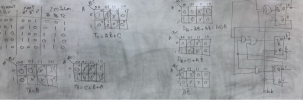 •Design a counter with repeated binary sequence 0,2,4,6,8 make the
table•From the table you made find the expression for the flip flop
input.•Draw the Kamaugh map for the flip flop Da,Db,Dc,Dd•Draw the logic diagram for the required counter.Please use the picture provided and write neat and clear as
possible. Thank you
•Design a counter with repeated binary sequence 0,2,4,6,8 make the
table•From the table you made find the expression for the flip flop
input.•Draw the Kamaugh map for the flip flop Da,Db,Dc,Dd•Draw the logic diagram for the required counter.Please use the picture provided and write neat and clear as
possible. Thank you
Designa synchronous counter using jk flip flops with the following repeated sequence: 0,1,2,3
Designa synchronous counter using jk flip flops with the following repeated sequence: 0,1,2,3
3. Use the D-type flip-flops and logic gates to design a counter with the following repeated...
 3. Use the D-type flip-flops and logic gates to design a counter with the following repeated binary sequence: 0,2,1,3,4,7,5,6. Here, you need to use the best suited state encoding scheme to reduce the number of logic gates. Mention the encoding scheme you want to implement.
Design a 2-bit counter using D Flip Flops that follows the sequence 0, 3, 2. Please...
Design a 2-bit counter using D Flip Flops that follows the sequence 0, 3, 2. Please provide explanation & Present/Future state table.
Design a Binary Counter with the repeating sequence of 100 - 110 - 111 - 011...
 Design a Binary Counter with the repeating sequence of 100 - 110 - 111 - 011 - 001 - 000 using T Flip-Flops. Find the input expressions of the T Flip-Flops by K-Map.
Using S-R flip-flops, design a 3-bit counter (C,B,A) with the repeating binary counting sequence: 1, 3,...
Using S-R flip-flops, design a 3-bit counter (C,B,A) with the repeating binary counting sequence: 1, 3, 2, 6, 7, 5, 4. - Show the circuit's state table with the present-state entries in ascending order, which should have the present state (t), next state (t+1), and flip-flop inputs. - Find the flip-flop input equations for RC, RB, and RA in Product of Sums form.
Design the following types of counters using only D flip flops: (A) synchronous binary up counter...
Design the following types of counters using only D flip flops: (A) synchronous binary up counter (B)synchronous binary down counter (C)synchronous binary up-down counter
 (2) Design a counter with the following repeated binary sequence: 0,2,3,4,6. Use D flip-flops. Note: Do verification if your circuit has some unused states.
 •Design a counter with repeated binary sequence 0,2,4,6,8 make the
table•From the table you made find the expression for the flip flop
input.•Draw the Kamaugh map for the flip flop Da,Db,Dc,Dd•Draw the logic diagram for the required counter.Please use the picture provided and write neat and clear as
possible. Thank you
•Design a counter with repeated binary sequence 0,2,4,6,8 make the
table•From the table you made find the expression for the flip flop
input.•Draw the Kamaugh map for the flip flop Da,Db,Dc,Dd•Draw the logic diagram for the required counter.Please use the picture provided and write neat and clear as
possible. Thank you
 3. Use the D-type flip-flops and logic gates to design a counter with the following repeated binary sequence: 0,2,1,3,4,7,5,6. Here, you need to use the best suited state encoding scheme to reduce the number of logic gates. Mention the encoding scheme you want to implement.
 Design a Binary Counter with the repeating sequence of 100 - 110 - 111 - 011 - 001 - 000 using T Flip-Flops. Find the input expressions of the T Flip-Flops by K-Map.
Most questions answered within 3 hours.
-
Where is the error in this code sequence?
String s1 = "Hello";
String s2 = "ello";...
asked 11 months ago -
Financial data for Joel de Paris, Inc., for last year
follow:
Joel de Paris, Inc.
Balance...
asked 11 months ago -
Consider this reaction:
Al2(SO4)3 (aq)+ BaCl3
(aq) Al2Cl6 (aq)- +
3BaSO4(s) . What is the...
asked 11 months ago -
Suppose that Savneet is considering increasing her
recent random sample from 20 car rentals to 40...
asked 11 months ago -
Trucks arrive at an unloading terminal at an average rate of 120
per hour.
Trucks arrive...
asked 11 months ago -
Why are methanol and ethanol completely soluble in water while
octanol is not very little soluble....
asked 11 months ago -
A facilities manager at a university reads in a research report
that the mean amount of...
asked 11 months ago -
When the CuSO4 is rehydrated by adding water to the anhydrous
compound, is this an endothermic...
asked 11 months ago -
A ray of sunlight is passing from diamond into crown glass; the
angle of incidence is...
asked 11 months ago -
A block of mass 0.249 kg is placed on top of a light, vertical
spring of...
asked 11 months ago -
how do the kidneys compensate in the presences of acidosis
a) trigger hyperventilate
b) reserve acid...
asked 11 months ago -
Question 501 pts
The rental rate of capital to the firm increases. Which of the
following...
asked 11 months ago